KAZALCI OKOLJA

Environmental indicators in Slovenia


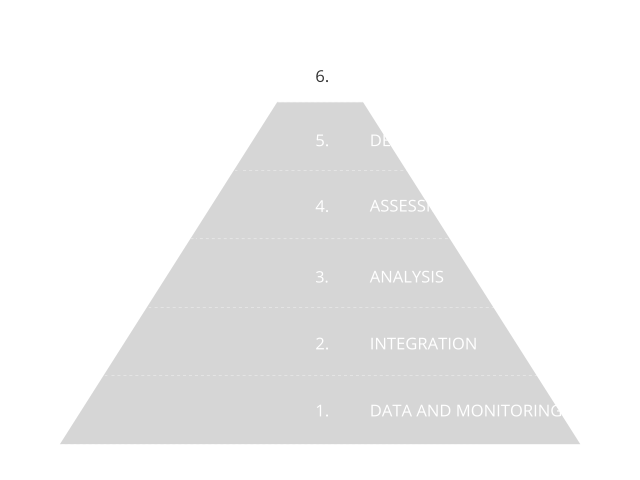
Environmental indicators are based on graphs, maps and assessments and as such present environmental trends in Slovenia. The indicators represent one of the four pillars of our environmental reporting, and are prepared in accordance with the Environmental Protection Act. The Environmental Indicators in Slovenia website enables users to browse among 180 indicators. They are based on numerical data and they indicate the state, characteristics and trends of environmental development in Slovenia. They are prepared using a systematic approach based on data and monitoring, as shown in the information pyramid.

Did you know?

Neutral

In the upcoming years our primary objective is to implement and maintain an effective system of managing waste batteries and accumulators.

Neutral

Overall energy efficiency of final energy consumption improved by 30 % between 2005 and 2024. The industrial sector contributed the most to this improvement, followed by households, while the transport sector contributed by far the least. In 2024, energy savings compared with 2005 amounted to 1,724 ktoe, equivalent to 44 % of the final energy consumption of the industry, transport and household sectors.

Bad

In 2025, 57,118 m2 of total floor area of public sector buildings were renovated within the cohesion policy programs, which was 38% less than in the previous year and the lowest level recorded in the 2018–2025 period. In line with the targets set out in the Long-term strategy for energy renovation of buildings by 2050, the energy renovation of 1,150,000 m² of public sector building floor area was planned for the 2021–2025 period; however, only just over half of this amount, or 578,145 m², was actually renovated.

Bad

In 2025, the leverage of incentives in the public sector amounted to 32.9 euro cents of subsidy for 1 euro of investment, which was 21 euro cents less than in 2024. The decline was due to the projects supported by the Eco Fund under the calls for co-financing new investments in the construction of highly energy-efficient, nearly zero-energy buildings of general public interest. For these projects, the leverage of incentives was only 13.3 euro cents of subsidy for 1 euro of investment, while they accounted for as much as 73% of the total value of supported investments.

Good

Net greenhouse gas (GHG) emissions in the LULUCF sector amounted to -4.452 kt CO2 eq in 2024, indicating that the sector was a net sink. Compared with 2005, the size of the net sink was 41% lower, mainly due to the impacts of natural disturbances in forests and increased harvesting levels over the past decade. According to the Slovenian Forest Service, timber harvesting in 2025 decreased by approximately 13% compared to 2024, while the share of sanitary fellings remained high, accounting for around 32% of total recorded harvesting.

Bad

Specific CO₂ emissions from new passenger cars amounted to 127 g CO₂/km in 2024 and decreased to 117 g CO₂/km in 2025. The increase in the share of electric passenger cars contributed significantly to this reduction. Nevertheless, the target value for the 2025–2029 period, set at 93.6 g CO₂/km, has not yet been achieved.

In 2024, average CO₂ emissions from all passenger cars amounted to 157.5 g CO₂/km and changed only marginally compared with 2023. The target value for 2020, set at 152 g CO₂/km, therefore remained unmet.