KAZALCI OKOLJA

Environmental indicators in Slovenia


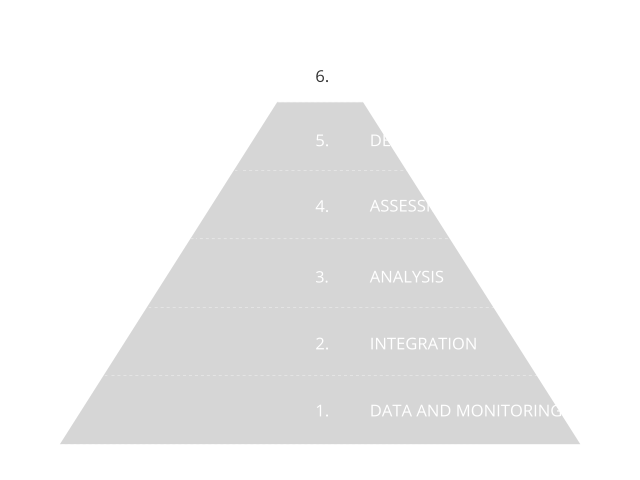
Environmental indicators are based on graphs, maps and assessments and as such present environmental trends in Slovenia. The indicators represent one of the four pillars of our environmental reporting, and are prepared in accordance with the Environmental Protection Act. The Environmental Indicators in Slovenia website enables users to browse among 180 indicators. They are based on numerical data and they indicate the state, characteristics and trends of environmental development in Slovenia. They are prepared using a systematic approach based on data and monitoring, as shown in the information pyramid.

Did you know?

Neutral

Due to high lead content in the environment, the Upper Meža Valley area was declared a brownfield site area in 2007 and underwent special remediation measures with the aim of protecting the health of people, especially children. Data shows that the lead exposure of children in the Upper Meža Valley improved rapidly in the early years of implementing the remediation measures, but no further improvement was observed after 2010. A prevalence study of lead levels in children's blood from the Meža Valley in 2018 even showed higher values compared to a study conducted in 2013.

Good

Foodborne diseases remain an important public health challenge and they are an important cause of morbidity and mortality worldwide. During 2018–2022 Slovenia reported 1152 different outbreaks. The most common were the respiratory disease outbreaks (902), outbreaks with contact transmission (186), followed by and foodborne disease outbreaks (22).

Good
Air

In Slovenia, total emissions of the pollutants that contribute to acidification and eutrophication have decreased by 81 % between 1990 and 2021. Emissions of SOx have decreased by 98 %, NOx by 66 % and NH3 by 22 %. The emissions of sulphur oxides, nitrogen oxides and ammonia were in 2021 below the prescribed target values. Slovenia also met its emission reduction commitments compared to the year 2005.

Good
Air

Emissions of total ozone precursors in Slovenia decreased by 62 % in the period 1990 to 2021. Emissions of nitrogen oxides decreased by 66 %, carbon monoxide by 70 %, non-methane volatile organic compounds by 54 % and methane by 26 %. The reason is mainly the introduction of more stringent emission standards for motor vehicles. This measure contributed to a significant reduction in emissions of nitrogen oxides and carbon dioxide from road transport which is the main source of ozone precursors.

Neutral

In 2023, Slovenia recorded a decrease in the number and total area of functionally derelict areas (FDAs): 1070 FDAs were registered with a total area of 3225.44 ha. This brings the situation closer to that of 2017, with a decrease of 62 in the number of FDAs and 469.83 ha in total area, compared to 2020.

Bad

The trend of food consumption after 2000 is slightly declining in almost all categories. One possible explanation for this decline is probably changed eating habits when we eat less at home. At the same time, there is a marked upward trend in food and beverage costs. The results of research show that of all food categories, meat and dairy products have the highest environmental impacts. The number of agricultural holdings with organic farming in Slovenia is slowly growing, but the dynamics of growth of organic production is not satisfactory.