KAZALCI OKOLJA

Environmental indicators in Slovenia


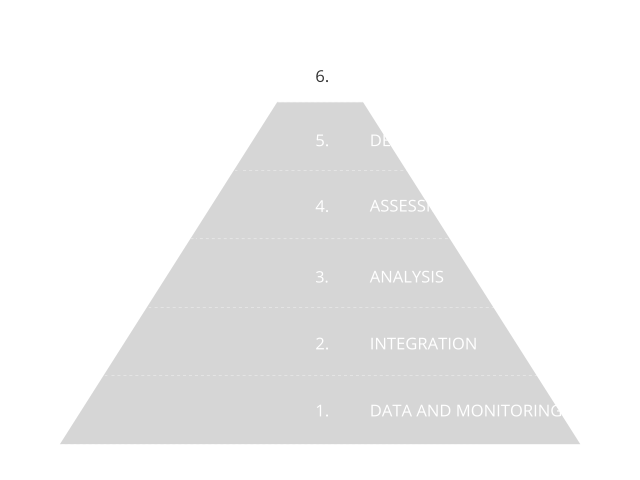
Environmental indicators are based on graphs, maps and assessments and as such present environmental trends in Slovenia. The indicators represent one of the four pillars of our environmental reporting, and are prepared in accordance with the Environmental Protection Act. The Environmental Indicators in Slovenia website enables users to browse among 180 indicators. They are based on numerical data and they indicate the state, characteristics and trends of environmental development in Slovenia. They are prepared using a systematic approach based on data and monitoring, as shown in the information pyramid.

Did you know?

Good

More than half of households in Slovenia have already used financial incentives for energy efficiency and renewable energy sources or are actively considering it. The index of household preferece for financial incentives offered by the Eco Fund increased positively by 4 index points from 2019 to 2022, when it was 52 on a scale from 0 to 100. Preference for these financial incentives varies between regions. On the one hand, knowledge and interest in the Eco Fund services is decreasing, while on the other hand, the share of households that have opted for these services again is increasing.

Good

Foodborne diseases remain an important public health challenge and they are an important cause of morbidity and mortality worldwide. During 2018–2022 Slovenia reported 1152 different outbreaks. The most common were the respiratory disease outbreaks (902), outbreaks with contact transmission (186), followed by and foodborne disease outbreaks (22).

Good
Air

Emissions of total ozone precursors in Slovenia decreased by 62 % in the period 1990 to 2021. Emissions of nitrogen oxides decreased by 66 %, carbon monoxide by 70 %, non-methane volatile organic compounds by 54 % and methane by 26 %. The reason is mainly the introduction of more stringent emission standards for motor vehicles. This measure contributed to a significant reduction in emissions of nitrogen oxides and carbon dioxide from road transport which is the main source of ozone precursors.

Good
Air

In Slovenia, total emissions of the pollutants that contribute to acidification and eutrophication have decreased by 81 % between 1990 and 2021. Emissions of SOx have decreased by 98 %, NOx by 66 % and NH3 by 22 %. The emissions of sulphur oxides, nitrogen oxides and ammonia were in 2021 below the prescribed target values. Slovenia also met its emission reduction commitments compared to the year 2005.

Neutral

In 2023, Slovenia recorded a decrease in the number and total area of functionally derelict areas (FDAs): 1070 FDAs were registered with a total area of 3225.44 ha. This brings the situation closer to that of 2017, with a decrease of 62 in the number of FDAs and 469.83 ha in total area, compared to 2020.

Bad

On average, households expenditure by consumption purpose in Slovenia was devoted predominantly on transport, housing, food and non-alcoholic beverages, which is similar to spending in the EU. The majority, a fifth of household spending, consisted of transport expenses. Energy poverty is present in approximately 7% of households, which is around 62,000 households or 102,000 inhabitants.