KAZALCI OKOLJA

Environmental indicators in Slovenia


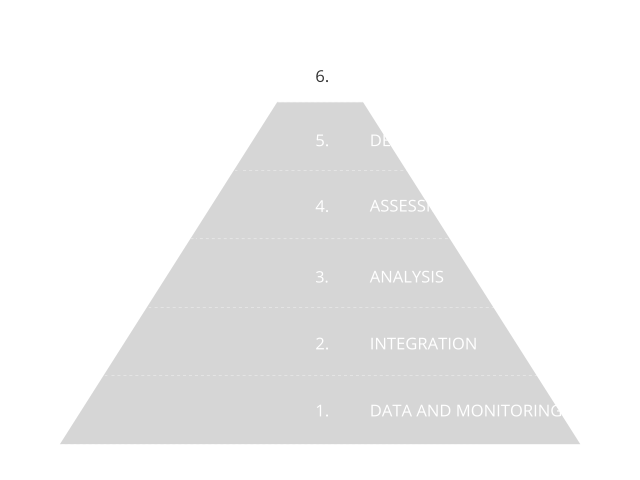
Environmental indicators are based on graphs, maps and assessments and as such present environmental trends in Slovenia. The indicators represent one of the four pillars of our environmental reporting, and are prepared in accordance with the Environmental Protection Act. The Environmental Indicators in Slovenia website enables users to browse among 180 indicators. They are based on numerical data and they indicate the state, characteristics and trends of environmental development in Slovenia. They are prepared using a systematic approach based on data and monitoring, as shown in the information pyramid.

Did you know?

Bad

Collected quantities of organic kitchen waste more than doubled after the implementation of the regulation, but its management has so far failed to achieve the set objectives. Deficiencies are particularly evident in composting. About 3,000 tonnes of such waste were composted in 2007, but so far only one entity obtained the environmental permit required for this activity.

Neutral

The implicit energy tax rate fluctuates throughout the entire observed period, but recently it has been gradually declining. In 2021, the value of the indicator for Slovenia was 7% lower than the EU-27 average. Before 2009, when it increased significantly, it was notably lower than the EU average. The reasons for the differences can be found mainly in the differences in the structure of energy use, where the share of liquid fuels for motor vehicles is significantly higher in Slovenia, and in the taxation levels of individual energy sources.

Neutral

The emission productivity in Slovenia improved in 2021 and amounted to 2,79 EUR2010/kg CO2 ekv. Despite the progress made in recent years, is, however, the progress in emission productivity in Slovenia when compared to the European Union (EU), still relatively slow, thus there is a need to further strengthen the connection between economic development and measures for reducing GHG emissions.

Bad

In 2016 and 2017, the trend of reducing specific emissions of new vehicles has stopped, and in 2018 and 2019 they have even increased. After a 10% reduction in 2020, the specific emissions of new vehicles remained almost unchanged in 2021, falling short of the target set for that year. In 2022, the specific emissions of new vehicles decreased again, by 6%.

In 2021, for the first time since 2016, the average emissions of all vehicles increased slightly in comparison to the previous year. Target values have not been achieved.

Neutral

After 2005, the gross nitrogen budget ranged between 32 and 69 kg per hectare of agricultural land with an indistinct downward trend. On average over the last five-year period, the target value (less than 50.4 kg per ha) was achieved. In 2022, the nitrogen balance surplus rose sharply compared to the previous year (from 46.2 to 69.1 kg per ha). The target value (less than 49.4 kg per ha) was therefore not achieved. The increase in the surplus is attributed to the drought, which caused a decrease in the nitrogen uptake by agricultural plants.

Neutral

Areas of fields and gardens in measures that require fertilization based on rapid soil or plant tests have significantly exceeded the target value set by the 2014–2020 Rural Development Programme.