KAZALCI OKOLJA

Environmental indicators in Slovenia


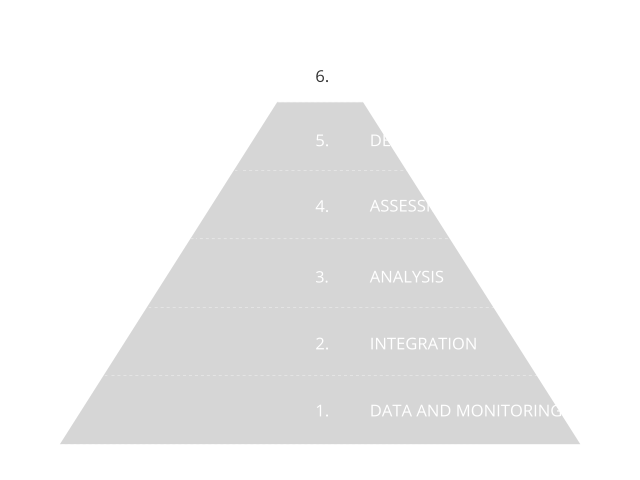
Environmental indicators are based on graphs, maps and assessments and as such present environmental trends in Slovenia. The indicators represent one of the four pillars of our environmental reporting, and are prepared in accordance with the Environmental Protection Act. The Environmental Indicators in Slovenia website enables users to browse among 180 indicators. They are based on numerical data and they indicate the state, characteristics and trends of environmental development in Slovenia. They are prepared using a systematic approach based on data and monitoring, as shown in the information pyramid.

Did you know?

Bad

The favorable conservation status of habitat types in Slovenia is reached by just over a third of Europe's important habitat types.In order to achieve the objectives of the EU Biodiversity Strategy, it is necessary to follow the guidelines of the Regulation on Special Conservation Areas (Natura 2000 sites) more rigorously and to implement the Natura 2000 management program. This is especially important for areas with freshwater, wetland, wetland and grassland habitat types.

Neutral

Although the annual number of road traffic fatalities in Slovenia has been declining for decades and has decreased to about a third since independence, traffic still requires an excessive tax. The number of traffic accidents with victims or serious injuries is at the level of 30 years ago, the number of serious injuries is already 15 years stagnant. Traffic accidents have claimed an average of almost 110 lives per year over the last ten years, and fortunately, the number of deaths in traffic accidents has been slightly decreasing over the past ten years.

Bad

Fuel prices could play an important role in the internalization of external transport costs, but this potential is not exploited in Slovenia. Determining the price of fuels has primarily an economic function and is not a tool of environmental policy. Fuel taxation is a function of the country's economic policy and responds to crude oil prices on the international market, which is a reflection of global supply and demand and geopolitical (in)stability.

Neutral

Slovenia belongs to the EU Member States with a lower level of specialization in agriculture. This is reflected in the number of specialized farms and the surface area of agricultural land treated by these holdings. Specialized farms in Slovenia generate a smaller share of standard output than the average in the European Union, which indicates that the processes of concentration and specialization of agricultural production in Slovenia is slower than in European Union.

Neutral

Changes in the size structure show that concentration processes are continuing regarding the extent of the agricultural land, while in the area of the livestock production these processes have slowed down. Nevertheless, due to its small size on average, the competitiveness of Slovenian farms is low compared to the EU–27 countries.

Good

The amount of waste from coal combustion is decreasing as a result of the reduction in the use of coal for electricity generation. In 2022, the amount was 15% lower than the previous year. By far the largest source is the Šoštanj thermal power plant. Most of the waste is used as fill material in mines.