KAZALCI OKOLJA

Environmental indicators in Slovenia


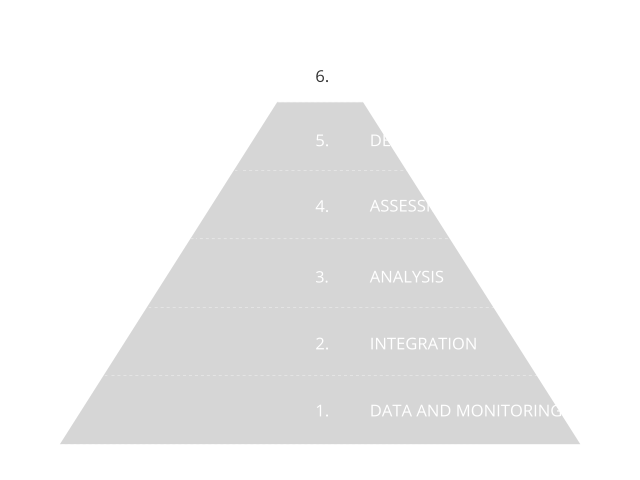
Environmental indicators are based on graphs, maps and assessments and as such present environmental trends in Slovenia. The indicators represent one of the four pillars of our environmental reporting, and are prepared in accordance with the Environmental Protection Act. The Environmental Indicators in Slovenia website enables users to browse among 180 indicators. They are based on numerical data and they indicate the state, characteristics and trends of environmental development in Slovenia. They are prepared using a systematic approach based on data and monitoring, as shown in the information pyramid.

Did you know?

Bad

Between 1980 and 2021, extreme events related to climate change in EU-27 resulted in an economic loss of EUR 560 billion, of which EUR 56.6 billion from 2021. Climate extremes are becoming more common. Without further action, even greater economic damage is expected in the future. This trend is also noticeable in Slovenia. The difference between the period 1980-2015 and 1980-2021 is as much as € 2,38 billion. In comparison to the previous period 1980-2020, the difference is € 1,01 billion.

Good

It is estimated that in 2021, over €396 million in energy subsidies was allocated in Slovenia (or 356 € million when adjusted to constant prices in 2015). Incentives for environmentally harmful energy production from fossil fuels and the use of fossil fuels represented 26% of all energy subsidies in 2021, whereas this share was as high as 51% in 2015. Significant progress is observed in subsidizing production from renewable energy sources, CHP, and energy efficiency measures.


Life expectancy at birth in Slovenia is gradually increasing for both men and women. It is slightly higher for women than for men. Longer life expectancy at birth is recorded in western Slovenia. In 2021, life expectancy at birth was 83.8 years for women and 77.7 years for men, with an average of 80.7 years in Slovenia compared to 80.1 years in the EU.

Bad

As of 2022, the Potentially Contaminated Sites (PCS) inventory in Slovenia includes 671 sites that are a potential source of pollution due to past or present activities. With the establishment of the first database, Slovenia has taken the first of six steps toward systematic management and monitoring of contaminated sites. An analysis of the degree of environmental sensitivity and threat to human health due to potential contamination revealed that priority treatment is urgent for 35 sites and very urgent for 196 sites.

Good

Foodborne diseases remain an important public health challenge and they are an important cause of morbidity and mortality worldwide. During 2018–2022 Slovenia reported 1152 different outbreaks. The most common were the respiratory disease outbreaks (902), outbreaks with contact transmission (186), followed by and foodborne disease outbreaks (22).

Good
Air

Emissions of total ozone precursors in Slovenia decreased by 62 % in the period 1990 to 2021. Emissions of nitrogen oxides decreased by 66 %, carbon monoxide by 70 %, non-methane volatile organic compounds by 54 % and methane by 26 %. The reason is mainly the introduction of more stringent emission standards for motor vehicles. This measure contributed to a significant reduction in emissions of nitrogen oxides and carbon dioxide from road transport which is the main source of ozone precursors.