KAZALCI OKOLJA

Environmental indicators in Slovenia


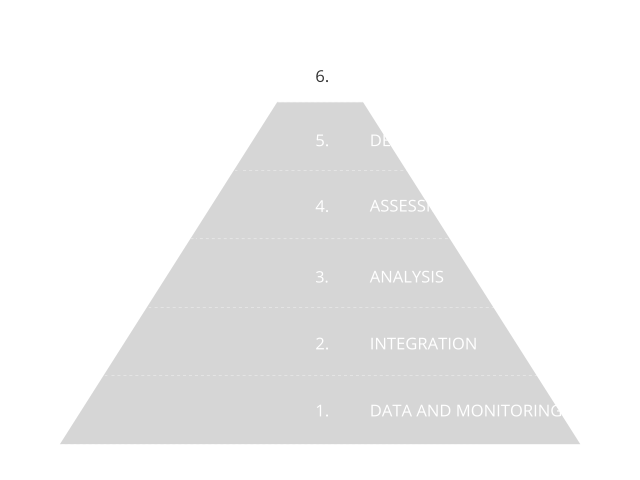
Environmental indicators are based on graphs, maps and assessments and as such present environmental trends in Slovenia. The indicators represent one of the four pillars of our environmental reporting, and are prepared in accordance with the Environmental Protection Act. The Environmental Indicators in Slovenia website enables users to browse among 180 indicators. They are based on numerical data and they indicate the state, characteristics and trends of environmental development in Slovenia. They are prepared using a systematic approach based on data and monitoring, as shown in the information pyramid.

Did you know?

Bad

With the increasing share of electric passenger vehicles, CO2 emissions decreased in 2022 and 2023, but increased slightly in 2024 compared to the previous year due to the decrease in the share. The gap to the target value is almost 34%.

The average emissions of all passenger vehicles increased in 2022 compared to the previous year. In 2023, the average emissions decreased back to approximately the level of 2021. The target values were not achieved.

Bad

Fuel prices could play an important role in the internalization of external transport costs, but this potential is not exploited in Slovenia. Determining the price of fuels has primarily an economic function and is not a tool of environmental policy. Fuel taxation is a function of the country's economic policy and responds to crude oil prices on the international market, which is a reflection of global supply and demand and geopolitical (in)stability.

Neutral

Soil erosion is a natural geomorphic process of soil particle detachment and transport. Due to human activities, it can be significantly accelerated, reaching levels much higher than in natural conditions. Erosion (water, wind, and tillage erosion) remains the most significant threat to soils in many regions of the world. Measuring erosion is typically done under controlled conditions on standardized test plots, which is a time-consuming, costly, and organizationally demanding process. Therefore, erosion risks and intensities are often assessed using computational models.

Neutral

Slovenia belongs to the EU Member States with a lower level of specialization in agriculture. This is reflected in the number of specialized farms and the surface area of agricultural land treated by these holdings. Specialized farms in Slovenia generate a smaller share of standard output than the average in the European Union, which indicates that the processes of concentration and specialization of agricultural production in Slovenia is slower than in European Union.

Neutral

Changes in the size structure show that concentration processes are continuing regarding the extent of the agricultural land, while in the area of the livestock production these processes have slowed down. Nevertheless, due to its small size on average, the competitiveness of Slovenian farms is low compared to the EU–27 countries.

Good

The amount of waste from coal combustion is decreasing as a result of the reduction in the use of coal for electricity generation. In 2022, the amount was 15% lower than the previous year. By far the largest source is the Šoštanj thermal power plant. Most of the waste is used as fill material in mines.