KAZALCI OKOLJA

Environmental indicators in Slovenia


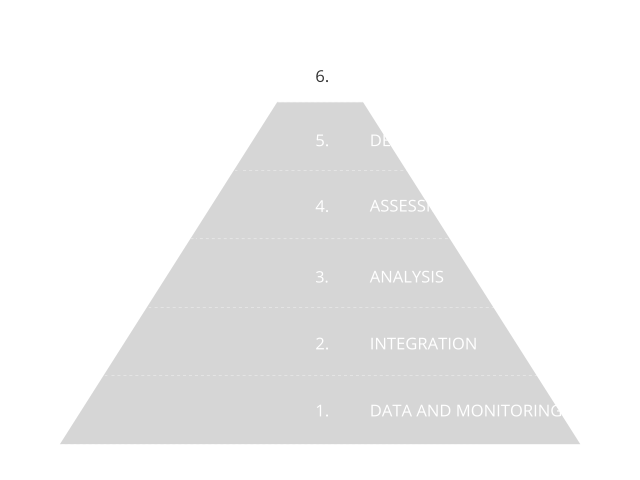
Environmental indicators are based on graphs, maps and assessments and as such present environmental trends in Slovenia. The indicators represent one of the four pillars of our environmental reporting, and are prepared in accordance with the Environmental Protection Act. The Environmental Indicators in Slovenia website enables users to browse among 180 indicators. They are based on numerical data and they indicate the state, characteristics and trends of environmental development in Slovenia. They are prepared using a systematic approach based on data and monitoring, as shown in the information pyramid.

Did you know?

Neutral

Slovenia reported one to two waterborne outbreaks per year during 20142024, except in 2015, 20172020 and 2023-2024, when no outbreaks were reported. Last outbreak was reported in 2022 in the Savinja region, caused by the norovirus genotype GII.6. During 20142024 between 3 and 405 cases were reported. Confirmed causative agents were Cryptosporidium parvum, Escherichia coli, rotavirus, norovirus, Bacillus cereus, Campylobacter jejuni, Salmonella Typhimurium and Francisella tularensis.

Bad

Between 1980 and 2021, extreme events related to climate change in EU-27 resulted in an economic loss of EUR 560 billion, of which EUR 56.6 billion from 2021. Climate extremes are becoming more common. Without further action, even greater economic damage is expected in the future. This trend is also noticeable in Slovenia. The difference between the period 1980-2015 and 1980-2021 is as much as € 2,38 billion. In comparison to the previous period 1980-2020, the difference is € 1,01 billion.

Bad
Air

In 2021, the levels of benzo(a)pyrene at all urban monitoring sites reached the target value. Annual trends of benzo(a)pyrene levels show that the highest levels are measured during the heating season. In summer, levels are significantly lower at all locations.

Neutral

The rate of defoliation and forest decline in Slovenia was relatively stable until 2020, with a slightly negative trend. After 2020, a deterioration of tree defoliation was observed.

Neutral

The large majority of organisations from the public sector and office-based companies (e.g. banks, post offices and other administrative and office premises) believe that increased energy efficiency of business premises is very important. About three quarters of organisations in both sectors think about using the energy more efficiently. For about a third of organisations from both sectors, which think about the efficient energy consumption, its main purpose is to decrease the quantity of energy used in their business premises.

Neutral

The large majority of organisations from the public and service sector believe that they are ecologically conscious and that they separate waste. The majority of organisations responded that the efficient use of energy in their business premises is important due to both reducing the costs and to protect the environment. Three quarters of companies and two thirds of public administration organisations have stated that they are well familiar with the environmental impact of their business premises.