KAZALCI OKOLJA

Environmental indicators in Slovenia


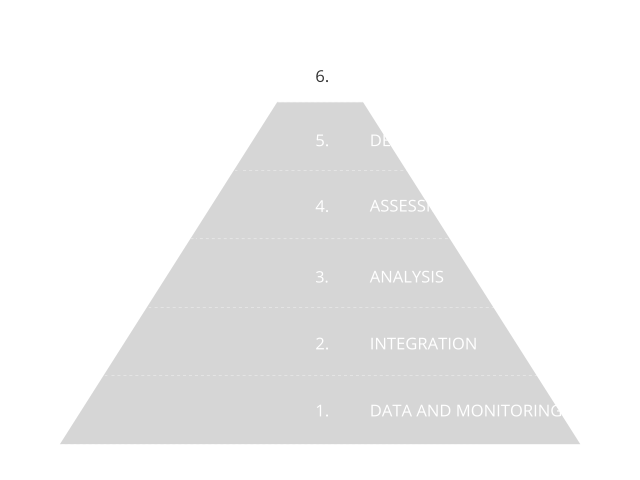
Environmental indicators are based on graphs, maps and assessments and as such present environmental trends in Slovenia. The indicators represent one of the four pillars of our environmental reporting, and are prepared in accordance with the Environmental Protection Act. The Environmental Indicators in Slovenia website enables users to browse among 180 indicators. They are based on numerical data and they indicate the state, characteristics and trends of environmental development in Slovenia. They are prepared using a systematic approach based on data and monitoring, as shown in the information pyramid.

Did you know?

Neutral

The values ​​of the parameters used to monitor the load of rivers with organic substances have decreased significantly since 1996. The observed decrease in organic load corresponds to the increase in the proportion of the population whose wastewater is treated in municipal and joint wastewater treatment plants. The load of rivers with nutrients varies significantly between river basins. The average nitrate values ​​in all river basins of the Danube river basin are higher than in the Soča and Adriatic river basins and above the values of the natural background.

Bad

In Slovenia, built-up areas continue to increase, representing 5.7% of the land use structure in 2023. In the period 2019-2023 built-up areas were predominantly spread to grasslands (42%), forest (18.6%) and the category other (16.1%), with the total built-up area increasing by 1,618.9 ha over this period. Existing data sources in Slovenia have recently made it possible to evaluate the actual loss of land to development.

Neutral

The intensity of final energy consumption as well as sectoral intensities in Slovenia have decreased over the period 2005-2022. Most in industry, least in transport. Comparison with the EU-27 shows that Slovenia is worse than the EU-27 average, but the gap has almost halved over the period 2005-2021, with contribution of all sectors except transport.

Neutral

The intensity of SO2, NOx and CO2 emissions from electricity and heat production in public thermal power plants in 2021 was significantly lower than in 2005, with SO2 emissions intensity 94% lower, NOx  71% lower and CO2 28% lower. Compared to the EU-27 average, the intensity of CO2 emissions in Slovenia in 2021 was higher, NOx emissions slightly lower and SO2 emissions significantly lower.

Neutral


During the period from 2012 to 2022, taxes on energy sources in Slovenia fluctuated, generally decreasing except for electricity for industrial consumers, where they increased due to levies. Between 2020 and 2022, temporary measures were introduced to reduce taxes on certain energy sources due to the COVID-19 pandemic and the war in Ukraine. Compared to the EU-27, the taxation of electricity and natural gas for households in Slovenia was lower, while it was higher for industrial consumers; diesel fuel taxation was higher, while gasoline taxation was lower.


Neutral

Over the period 1990-2022, the amount of spent nuclear fuel, the only high-level radioactive waste, increased at an average rate of 5% per year. In the absence of a satisfactory permanent storage solution, there are concerns about the accumulation of this waste.