KAZALCI OKOLJA

Environmental indicators in Slovenia


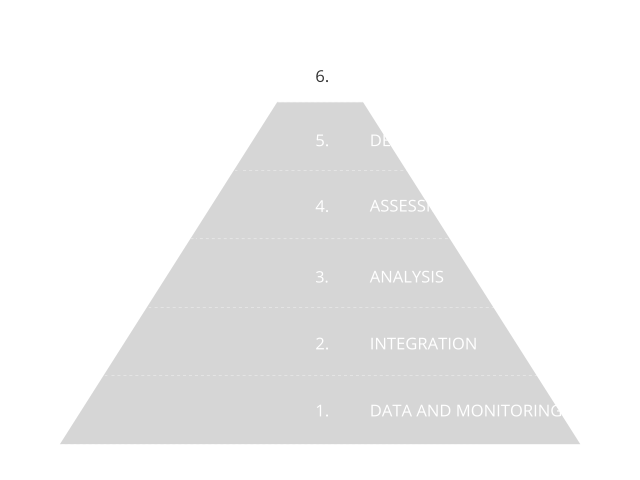
Environmental indicators are based on graphs, maps and assessments and as such present environmental trends in Slovenia. The indicators represent one of the four pillars of our environmental reporting, and are prepared in accordance with the Environmental Protection Act. The Environmental Indicators in Slovenia website enables users to browse among 180 indicators. They are based on numerical data and they indicate the state, characteristics and trends of environmental development in Slovenia. They are prepared using a systematic approach based on data and monitoring, as shown in the information pyramid.

Did you know?

Bad

In 2018, the ecological footprint of Slovenia was 5,37 gha per capita while biocapacity was 2.2 gha. For such a lifestyle 3.39 Earths would be required for the world's population to live within planetary regenerative capacity. This places Slovenia above the average of the EU countries (4.6 gha per capita). The carbon footprint usually accounts for around 60% of the total ecological footprint and therefore needs to receive comparatively more attention. According to consumption categories, housing and personal transportation contribute the most to the ecological footprint in Slovenia.

Good

In Slovenia, the number of companies registered under ISO 14001 and EMAS schemes, as well as the number of awarded EU Ecolabels, is gradually increasing. In the year 2021, the number of ISO 14001 certificates significantly increased (by 63), while in 2022, there was a rise in environmental EU Ecolabel (by 15). In terms of the number of awarded ISO 14001 certificates and EU Ecolabels per million inhabitants, Slovenia ranks above the EU-27 average on a European scale. However, its performance is slightly weaker in the field of EMAS, where Slovenia falls below the EU-27 average.

Neutral

Air pollution with PM10 was the lowest in 2021 since we have been carrying out measurements. For the first time, at no monitoring site did the sum of exceeding the daily limit value for PM10 (50 µg/m3) exceed the number of 35, which is allowed for the whole year. Even the annual limit value for PM10 in 2021 was not exceeded at any monitoring site.

Bad

Between 1980 and 2021, extreme events related to climate change in EU-27 resulted in an economic loss of EUR 560 billion, of which EUR 56.6 billion from 2021. Climate extremes are becoming more common. Without further action, even greater economic damage is expected in the future. This trend is also noticeable in Slovenia. The difference between the period 1980-2015 and 1980-2021 is as much as € 2,38 billion. In comparison to the previous period 1980-2020, the difference is € 1,01 billion.

Bad
Air

In 2021, the levels of benzo(a)pyrene at all urban monitoring sites reached the target value. Annual trends of benzo(a)pyrene levels show that the highest levels are measured during the heating season. In summer, levels are significantly lower at all locations.

Neutral

The rate of defoliation and forest decline in Slovenia was relatively stable until 2020, with a slightly negative trend. After 2020, a deterioration of tree defoliation was observed.