KAZALCI OKOLJA

Environmental indicators in Slovenia


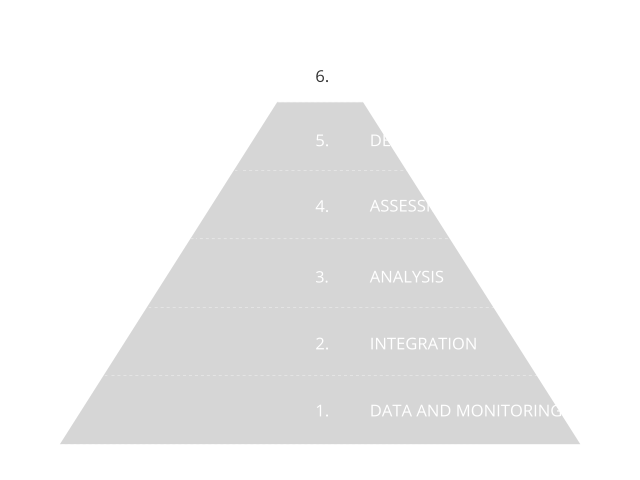
Environmental indicators are based on graphs, maps and assessments and as such present environmental trends in Slovenia. The indicators represent one of the four pillars of our environmental reporting, and are prepared in accordance with the Environmental Protection Act. The Environmental Indicators in Slovenia website enables users to browse among 180 indicators. They are based on numerical data and they indicate the state, characteristics and trends of environmental development in Slovenia. They are prepared using a systematic approach based on data and monitoring, as shown in the information pyramid.

Did you know?

Good

The amount of waste from coal combustion is decreasing as a result of the reduction in the use of coal for electricity generation. In 2022, the amount was 15% lower than the previous year. By far the largest source is the Šoštanj thermal power plant. Most of the waste is used as fill material in mines.

Bad

In 2024, 118,700 m2 of total floor area of public sector buildings were renovated within the cohesion policy programs, and in the period 2021–2024, 548,200 m2 or 60% of the value planned in the Long-term strategy for energy renovation of buildings by 2050. Within the OP EKP 1.08 million m2 of total floor area were renovated by the end of 2024, which is at the level of the OP EKP target value. For the energy renovation of buildings owned and occupied by the central government the gap behind the target from OP EKP was significant.

Neutral

By 2024, the implementation of energy efficiency (EE) and renewable energy source (RES) measures in the public sector resulted in a cumulative energy savings of 358 GWh, and the cumulative CO2 emissions reduction was 87 kt. The 2020 target values were only achieved in 2023 and 2022. The gap is largely due to the insufficient intensity of investments in 2016 and 2017. The transition from one financial perspective to the other is expected to be visible also in 2025. No 2030 targets have been set for this indicator.

Good

The cumulative final energy savings due to the implementation of energy efficiency (EE) and renewable energy source (RES) measures in the residential sector amounted to 1,130 GWh in the period 2021–2024, and the cumulative CO2 emissions reduction was 264 kt. Compared to the previous year, annual energy savings decreased by 3%, while the reduction in CO2 emissions increased by a good one percent, making it the highest in the observed period.

Bad

Slovenian forests are over-mature, the current ratio of forest development phases is unfavourable, forest regeneration is too slow, or the areas of forests under restoration are too small to significantly change the share of forest development phases and thus ensure sustainable forest development. The role of forests as a carbon sink is at risk.

Neutral

Most Slovenian forests are still undergoing natural regeneration, which guarantees the stability of future forest stands and adaptation to the changing site conditions caused by climate change. Restoration by planting seedlings and sowing (artificial regeneration) only complements natural regeneration when disturbances occur in the process of the natural regeneration of the forest, e.g. where there is no possibility of natural seeding, with the risk of developing erosion processes on exposed forest areas (e.g.