KAZALCI OKOLJA

Environmental indicators in Slovenia


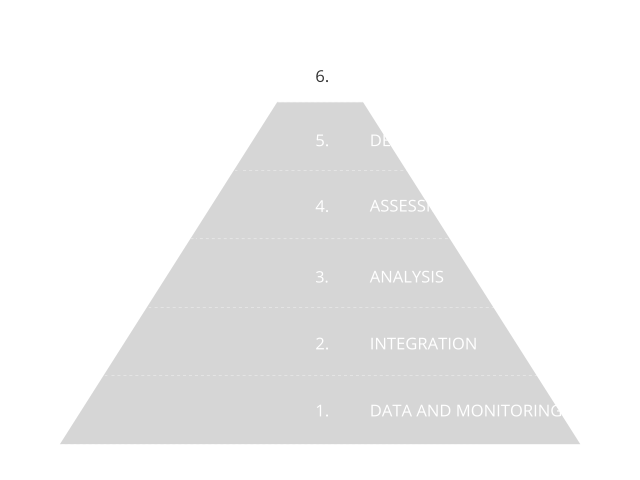
Environmental indicators are based on graphs, maps and assessments and as such present environmental trends in Slovenia. The indicators represent one of the four pillars of our environmental reporting, and are prepared in accordance with the Environmental Protection Act. The Environmental Indicators in Slovenia website enables users to browse among 180 indicators. They are based on numerical data and they indicate the state, characteristics and trends of environmental development in Slovenia. They are prepared using a systematic approach based on data and monitoring, as shown in the information pyramid.

Did you know?

Neutral

The year 2022 was exceptional for electricity production in Slovenia, as difficulties with coal supplies led to the lowest production from solid fuels since 1992, and drought also reduced production from renewable energy sources. This resulted in a record share of nuclear energy in electricity production (42%) and very low total production (13.4 TWh), the lowest since 1999. The share of domestic electricity production was 71%, below the target set in the National Energy and Climate Plan, and the annual production was 40% lower than the gross consumption.

Neutral

In Slovenia, the intensity of agricultural production increased moderately in the period 2000–2023. The main reasons for this are the continuous decrease of the number of agricultural holdings and the relatively stable volume of agricultural production. The concentration took place primarily in the direction of improving the labour intensity of agricultural production or reducing the labour input per unit of area or product. In the period 2000-2020 the stocking density per hectare of utilized agricultural area is slightly decreased.

Neutral

Despite the fact that the level of education on Slovenian agricultural holdings has significantly improved in the period 2000-20120, it is still quite unfavourable. Still, more than half of the farmers have only practical experience with work in agriculture. In all age classes, the number of farmers who have completed one of the forms of formal agricultural education is increasing. Under the Rural Development Program 2014-2020, 133,320 participants participated in education and training in the sub-measure M01.1: Support for vocational training and skills acquisition actions.

Good
Air

Concentrations of nitrogen dioxide and total nitrogen oxides in ambient air do not exceed the prescribed limit values. Consequently, they are not harmful for human health and vegetation.

Neutral

Asthma is the most common chronic disease among children and one of the major causes of hospitalization to the age of fifteen. In 2019, in EU countries, the share of people reporting asthma was 5,7 %, and for Slovenia it was 4,8 %.  In the period 2018-2022, the municipality of Kostel stood out in terms of the number of hospitalizations for asthma. Children admitted to the hospital for asthma in 2023 were mostly 5 to 9 years old.

Neutral

Heatwaves have a significant impact on public health as they can lead to increased mortality. The most vulnerable groups include elderly individuals and patients with chronic conditions such as cardiovascular diseases, respiratory illnesses, mental disorders, diabetes, and obesity. An analysis of the association between heatwaves and increased or decreased mortality (time series from 2020 to 2022) was conducted based on diagnoses (all causes, cardiovascular diseases), gender, and age group (all age groups and those aged 75 and older).