KAZALCI OKOLJA

Environmental indicators in Slovenia


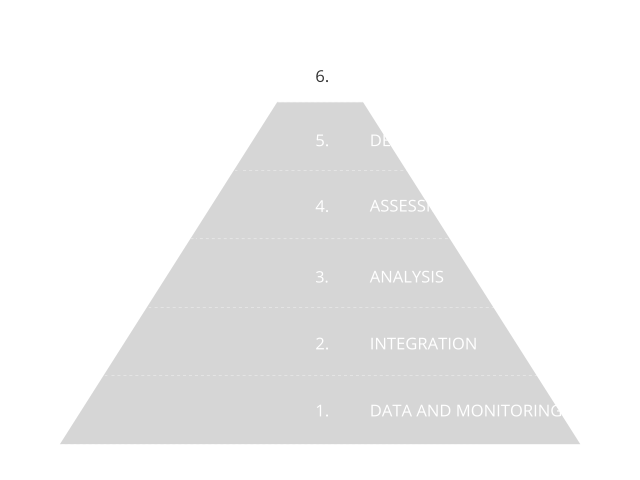
Environmental indicators are based on graphs, maps and assessments and as such present environmental trends in Slovenia. The indicators represent one of the four pillars of our environmental reporting, and are prepared in accordance with the Environmental Protection Act. The Environmental Indicators in Slovenia website enables users to browse among 180 indicators. They are based on numerical data and they indicate the state, characteristics and trends of environmental development in Slovenia. They are prepared using a systematic approach based on data and monitoring, as shown in the information pyramid.

Did you know?

Neutral

Due to high lead content in the environment, the Upper Meža Valley area was declared a brownfield site area in 2007 and underwent special remediation measures with the aim of protecting the health of people, especially children. Data shows that the lead exposure of children in the Upper Meža Valley improved rapidly in the early years of implementing the remediation measures, but no further improvement was observed after 2010. A prevalence study of lead levels in children's blood from the Meža Valley in 2018 even showed higher values compared to a study conducted in 2013.

Bad

In 2024, the share of RES in transport, after an increase in 2023, dropped again and amounted to 9,2%. With this, it was 1,6 percentage points behind the non-binding 2024 target from the updated National Energy and Climate Plan (NECP 2024).

Neutral

According to the projection based on existing measures, total greenhouse gas (GHG) emissions will remain at a level similar to today's until 2030 and will then begin to decline. Under the projection that includes additional measures, however, emissions will decrease dramatically – by 35% by 2030 and by 88% by 2050. The projections indicate that, with the intensive implementation of measures, it is possible to achieve the targets set for reducing total GHG emissions, as well as emissions from sources not covered by the Emissions Trading System (ETS).

Bad

Specific CO₂ emissions from new passenger cars amounted to 127 g CO₂/km in 2024 and decreased to 117 g CO₂/km in 2025. The increase in the share of electric passenger cars contributed significantly to this reduction. Nevertheless, the target value for the 2025–2029 period, set at 93.6 g CO₂/km, has not yet been achieved.

In 2024, average CO₂ emissions from all passenger cars amounted to 157.5 g CO₂/km and changed only marginally compared with 2023. The target value for 2020, set at 152 g CO₂/km, therefore remained unmet.

Good

Slovenia has a relatively high level of energy intensity, although it has been declining, particularly rapidly in recent years. Between 2005 and 2023, energy intensity decreased at an average annual rate of 3.2%. In 2024, energy intensity increased for the first time since 2016, rising by 2.1%. In 2024, Slovenia’s energy intensity was 37% higher than the EU-27 average, which is 15 percentage points less than in 2005.

Neutral

In 2024, greenhouse gas (GHG) emissions from sources covered by Regulation (EU) 2023/857 increased by 1.8% compared to the previous year. Nevertheless, they remained 0.4% (41 kt CO₂ eq) below the annual target set under the Regulation. The National Energy and Climate Plan from 2024 (NECP 2024) sets a more ambitious 2030 target for reducing non-ETS emissions than the EU Regulation. A comparison with the indicative trajectory towards this target, starting in 2021, shows that emissions were 5 percentage points above the trajectory in 2024.