KAZALCI OKOLJA

Environmental indicators in Slovenia


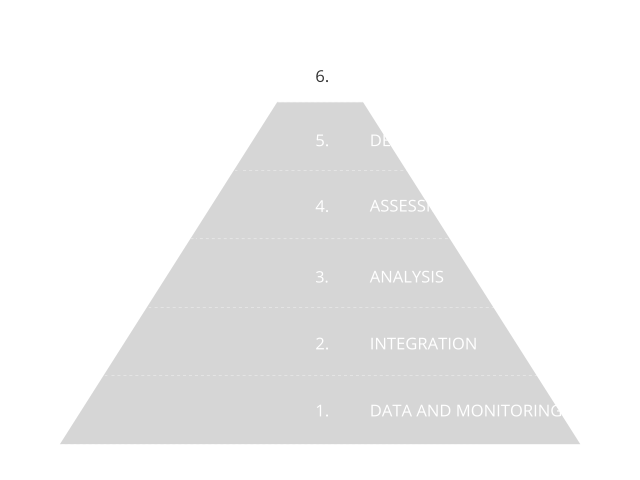
Environmental indicators are based on graphs, maps and assessments and as such present environmental trends in Slovenia. The indicators represent one of the four pillars of our environmental reporting, and are prepared in accordance with the Environmental Protection Act. The Environmental Indicators in Slovenia website enables users to browse among 180 indicators. They are based on numerical data and they indicate the state, characteristics and trends of environmental development in Slovenia. They are prepared using a systematic approach based on data and monitoring, as shown in the information pyramid.

Did you know?

Bad

In 2018, the ecological footprint of Slovenia was 5,37 gha per capita while biocapacity was 2.2 gha. For such a lifestyle 3.39 Earths would be required for the world's population to live within planetary regenerative capacity. This places Slovenia above the average of the EU countries (4.6 gha per capita). The carbon footprint usually accounts for around 60% of the total ecological footprint and therefore needs to receive comparatively more attention. According to consumption categories, housing and personal transportation contribute the most to the ecological footprint in Slovenia.

Good

The indicator “Public Attitude towards Energy Consumption” points to a stagnation in the self-assessment of final energy consumption in households. The share of households that estimated their energy consumption as low or very low was increasing between 2010 and 2019, but then the trend reversed, and by 2025 it had decreased by 6 percentage points, returning to a similar level as in 2010. A similar situation is observed with households considering more efficient energy use.

Good

The energy efficiency preference index among single-family homeowners is 46 (on a scale of 0 to 100), indicating untapped potential for improvement. The analysis reveals a divided market: approximately a fifth of households are completely passive, living in energy-inefficient homes and not considering renovation. Most of the remaining households are already on the path to greater efficiency, either by actively considering renovation or by having already updated individual elements such as windows, the facade, or the roof.

Neutral
Air

Emissions of primary particles smaller than 10 µm (PM10), particles smaller than 2.5 µm (PM2.5), and all total suspended particles (TSP) decreased in Slovenia in the period 2000–2023 by 26 %, 36 %, and 11 %, respectively. The main source of particulate matter emissions are households, mainly due to the use of biomass for domestic heating.

Good

In 2023, agriculture accounted for 97.4% of total ammonia emissions. From 1990 to 2024, ammonia emissions in Slovenian agriculture decreased by 31.0% and by 15.7% since 2005. Slovenian agriculture is achieving the overall emissions target set out in the NEC Directive (a gradual reduction of at least 15% by 2030 compared to 2005).

Good
Air

In Slovenia, emissions of persistent organic pollutants (polychlorinated biphenyl, polycyclic aromatic hydrocarbons, hexachlorobenzene, dioxins and furans) decreased between 1990-2023, primarily due to targeted legislation, improved control and use of best available technologies.