KAZALCI OKOLJA

Environmental indicators in Slovenia


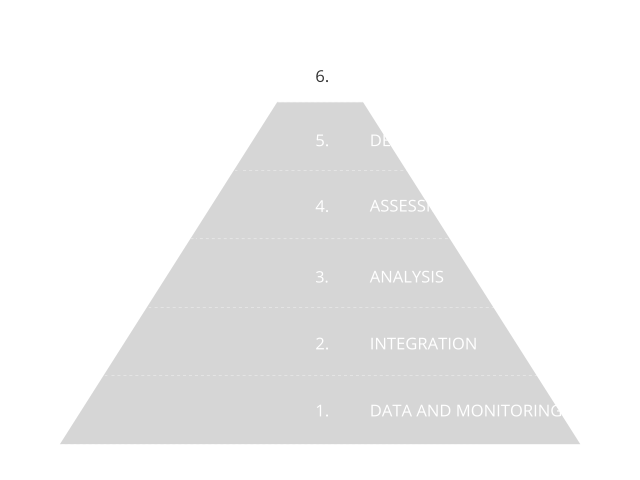
Environmental indicators are based on graphs, maps and assessments and as such present environmental trends in Slovenia. The indicators represent one of the four pillars of our environmental reporting, and are prepared in accordance with the Environmental Protection Act. The Environmental Indicators in Slovenia website enables users to browse among 180 indicators. They are based on numerical data and they indicate the state, characteristics and trends of environmental development in Slovenia. They are prepared using a systematic approach based on data and monitoring, as shown in the information pyramid.

Did you know?

Neutral

The results of the Slovenian Energy Efficiency Survey (REUS) 2019 show that over three quarters of all households decrease their greenhouse gas emissions by walking short distances, about half of them travel by bike, 1 in 7 uses public transport and 1 in 8  uses car sharing. Seven out of ten households were willing to combine their personal vehicle with other forms of transportation in their daily travel.

Good

In 2023, around 182 million pieces of plastic carrier bags were placed on the Slovenian market, of which 99% were those with a wall thickness of less than 50 microns (light plastic carrier bags). In Slovenia, the consumption of lightweight plastic carrier bags amounted to 85 bags per capita in 2023 In the same year, 145.9 million pieces of single-use food containers made wholly or partly of plastic and 174.4 million pieces of single-use beverage cups made wholly or partly of plastic were placed on the Slovenian market.

Bad

In the period 2003-2024, the highest exposure to ozone concentrations were detected in the Primorska region in summer where air quality measuring stations in Koper and Nova Gorica Grčna detected highest ozone concentrations in ambient air. There are some differences from year to year in a level of ozone exposure due to meteorological conditions in the warm half of the year and other regional characteristics.

Good

Slovenia is building its tourism development around sustainable principles — preserving nature, supporting local communities, and creating high-quality experiences. Tourism in Slovenia achieved high growth again in 2024 and 2025. At the same time, the implementation and expansion of the Green Scheme of Slovenian Tourism, a national certification program, is being strengthened, which now includes more than 280 label holders under the umbrella brand SLOVENIA GREEN and introduces new areas (culinary, digital monitoring of indicators, pilot circular practices).

Bad

Lyme borreliosis (LB) and tick-borne encephalitis (TBE) are the most common vector-borne diseases transmitted by ticks. Between 2014 and 2023, Slovenia reported annually slightly less than 3,000 to over 7,000 cases of LB and an average of 105 TBE cases (the highest in 2020 - 187 cases, the lowest in 2015 and 2021 - 62 cases). Due to climate change, which influences the expansion of tick habitats and extends their activity season, the risk of infection may increase in the future. Increased awareness and individual prevention are key factors in reducing the burden of both diseases.

Neutral

In Slovenia, we cultivate slightly more than 8 acres (0.08 hectares) of arable land per capita, which more than third of the average in the European Union (EU), which is 22 acres of arable land per capita (data for year 2023). This area did not change significantly between 2000 and 2023, which indicates that Slovenia maintains its production potential.