KAZALCI OKOLJA

Environmental indicators in Slovenia


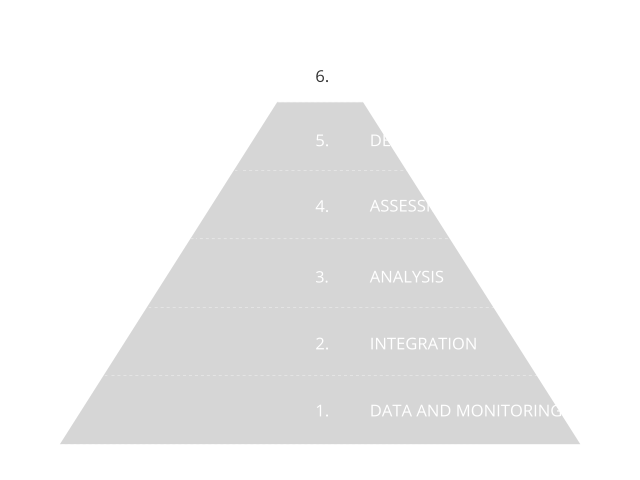
Environmental indicators are based on graphs, maps and assessments and as such present environmental trends in Slovenia. The indicators represent one of the four pillars of our environmental reporting, and are prepared in accordance with the Environmental Protection Act. The Environmental Indicators in Slovenia website enables users to browse among 180 indicators. They are based on numerical data and they indicate the state, characteristics and trends of environmental development in Slovenia. They are prepared using a systematic approach based on data and monitoring, as shown in the information pyramid.

Did you know?

Good

The population of brown bear in Slovenia is in a favorable state of preservation, with a trend of improvement. The estimated number of bears in spring was 990.

The population is the northwestern part of the Dinaric-Pind population, which was in 2012  estimated at 3950 individuals and is stable or growing.

Neutral

Most Slovenian forests are still undergoing natural regeneration, which guarantees the stability of future forest stands and adaptation to the changing site conditions caused by climate change. Restoration by planting seedlings and sowing (artificial regeneration) only complements natural regeneration when disturbances occur in the process of the natural regeneration of the forest, e.g. where there is no possibility of natural seeding, with the risk of developing erosion processes on exposed forest areas (e.g.

Good

In 2024, the energy reduction in the energy efficiency obligation scheme (EEOS) and alternative measure, t. i. Eco Fund programs, amounted to 671 GWh. The savings were more than a half lower than the previous year, mainly due to the fact that the EEOS obligated parties covered their obligations to a large extent with surpluses of savings from previous years. The target value for 2024 was nevertheless exceeded by 38% – because of the transfer of the part of the surplus savings from 2023 within the EEOS the energy savings amounted to 1,028 GWh.

Neutral

The level of household consumption, as well as savings or investments, largely depends on disposable income. It is a fundamental indicator of household material well-being. Household consumption in Slovenia fell significantly during the pandemic in 2020, while disposable income maintained positive growth. A few years later, in 2024, household consumption recorded a 1.6% growth. In the same year, disposable income per capita grew in all statistical regions; the highest in the Osrednjeslovenska region and the lowest in the Pomurska region.

Neutral

One of the main reasons of mortality due to respiratory diseases is in Slovenia chronic pulmonary disease (COPD). The highest mortality rate due to respiratory diseases in Slovenia is in Podravska and Pomurska region and the lowest in Central-Slovenian region (2022–2024). Mortality due to respiratory diseases is decreasing; in the period 2017 to 2021 it decreased from 62/100.000 inhabitants to 43/100.000 inhabitants in the year 2024. This can be attributed to the “harvesting effect” of COVID 19.

Good

The quality of inland bathing waters in Slovenia is high, as most are classified as “excellent”, which is better than in the majority of other EU Member States.