KAZALCI OKOLJA

Environmental indicators in Slovenia


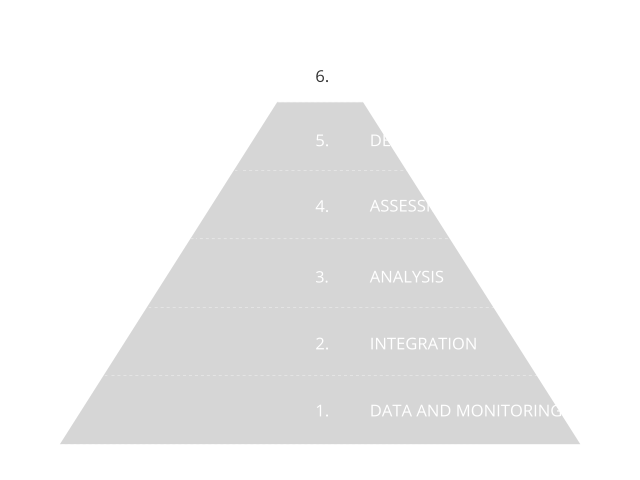
Environmental indicators are based on graphs, maps and assessments and as such present environmental trends in Slovenia. The indicators represent one of the four pillars of our environmental reporting, and are prepared in accordance with the Environmental Protection Act. The Environmental Indicators in Slovenia website enables users to browse among 180 indicators. They are based on numerical data and they indicate the state, characteristics and trends of environmental development in Slovenia. They are prepared using a systematic approach based on data and monitoring, as shown in the information pyramid.

Did you know?

Good

In the past centuries, forest area has been increasing constantly after 2010; however, the rate of expansion has slowed down and remains relatively stable in recent years. Since 1875, when forests covered only 36% of the Slovenian territory, forest cover has increased to 58.5% in the year 2009 and rests stable today at 58.0 %. In terms of forest share, Slovenia ranks third among EU-28 countries, behind Sweden and Finland.

Bad

In the first decade of this century, Slovenia directed most of its investments into the road network, primarily the construction of the motorway cross. The railways, on the other hand, were largely neglected in terms of investment, making them uncompetitive compared to road transport.

Bad

In Slovenia, the volume of passenger transport and traffic has been increasing over the past few decades. In particular, there has been a steady rise in one of the most environmentally damaging modes of transport – car travel. Its share places Slovenia in the unenviable fourth place among EU member states whose residents rely most heavily on private cars for their journeys.

Bad

Road freight transport in Slovenia has grown sharply since the country’s accession to the EU, with the volume of tonne-kilometres carried by Slovenian hauliers alone increasing more than 2.5 times between 2004 and 2024. After the pandemic-related slowdown, the volume of road freight transport returned to previous levels.

Neutral

In Slovenia, the market prices follow the trends at the key agricultural markets, globally or regionally important. Market prices of grain are following the trend and the level of EU average, prices of beef are below EU average while the market prices of poultry meat, pig meat and eggs are above the EU average. Slovenia stands out with its market prices of milk, which are among the lowest in the EU.

Bad

Slovenia is a net importer of food, as domestic production does not cover the total domestic needs (especially for vegetables, fruit, potatoes and pig meat). The long-term trend indicates that the self-sufficiency rate is higher and more stable for animal products (milk, eggs, beef and poultry meat), except for pig meat and honey, where the self-sufficiency rate is noticeably decreasing. In the analysed period, surpluses occurred only in the domestic production of milk, beef, poultry meat, in some years in eggs and honey, and in recent years in the production of grain maize.