KAZALCI OKOLJA

Environmental indicators in Slovenia


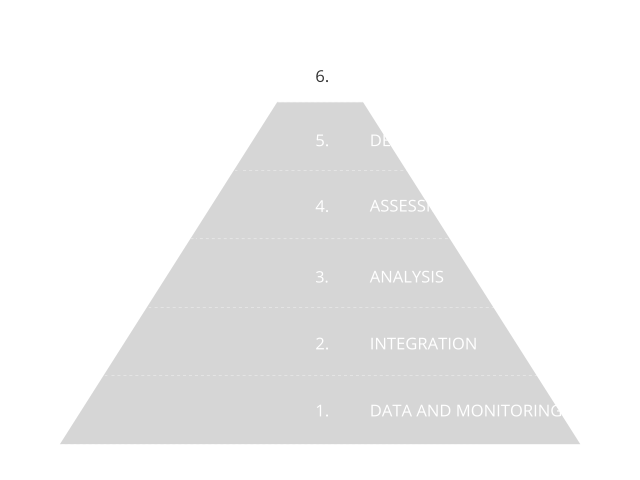
Environmental indicators are based on graphs, maps and assessments and as such present environmental trends in Slovenia. The indicators represent one of the four pillars of our environmental reporting, and are prepared in accordance with the Environmental Protection Act. The Environmental Indicators in Slovenia website enables users to browse among 180 indicators. They are based on numerical data and they indicate the state, characteristics and trends of environmental development in Slovenia. They are prepared using a systematic approach based on data and monitoring, as shown in the information pyramid.

Did you know?

Bad

In the last decade (2012–2021), on average around 135,000 tons of hazardous waste was generated annually in Slovenia. This waste accounted for 1% to 3% of all generated waste in Slovenia. Since they contain substances harmful to the environment and health, they must be collected, recovered or disposed of separately from other waste.

In the last decade (2012–2021) each resident of Slovenia annually discards on average around 3.5 kg of hazardous municipal waste, of which the majority in waste electrical and electronic equipment (63%).


The number and area of wildfires varies greatly between years, as the incidence depends on the weather conditions in each year. In Slovenia, the western, sub-Mediterranean part of the country is the most endangered. Climate change will also pose a greater fire risk in the eastern part of Slovenia.

Bad

In 2019, the material footprint of households in Slovenia amounted to around 15 tons per inhabitant, which is more than the EU average (14.6 tons per inhabitant). Finland, Romania, Estonia and Luxembourg have the largest material footprint with around 28-29 tonnes per capita, the Netherlands the lowest with 7.4 tonnes.

Bad

Households in lower income classes self-assess their health status worse than households in higher income classes, but in general, the self-assessment of the health status of Slovenian residents is relatively high. In 2019, a good third of adults in Slovenia (from 18 to 64 years inclusive) were overweight and almost a fifth were obese. Obesity is increasing, which is on the rise among the oldest, but also among children.

Bad

Slovenians are big meat lovers. Data for 2021 show that we eat a lot of meat (all types of meat are included here), 89.28 kg per capita; the European average is 69.3 kg. We are also big consumers of eggs, with which we are almost self-sufficient, while fish consumption is modest and declining. However, the amount of food waste should not be neglected. A resident of Slovenia threw away an average of 72 kg of food in 2021, and most food waste is generated in households.

Bad

The eco-innovation index shows the performance of individual Member States in the various components of eco-innovation compared to the EU average, and presents their strengths and weaknesses. The overall Eco-innovation Index 2019 for Slovenia is 94, placing Slovenia on 15th rank and below the EU average. Slovenia composite index has significantly deteriorated compared to 2017, when it was at 115; placing Slovenia just behind the leading eco-innovative countries.