KAZALCI OKOLJA

Environmental indicators in Slovenia


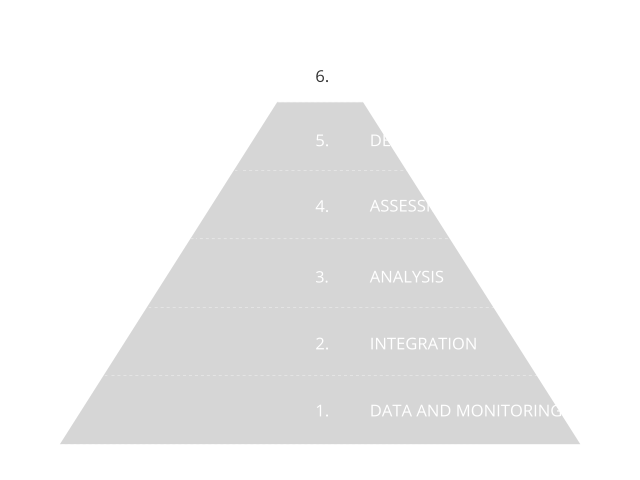
Environmental indicators are based on graphs, maps and assessments and as such present environmental trends in Slovenia. The indicators represent one of the four pillars of our environmental reporting, and are prepared in accordance with the Environmental Protection Act. The Environmental Indicators in Slovenia website enables users to browse among 180 indicators. They are based on numerical data and they indicate the state, characteristics and trends of environmental development in Slovenia. They are prepared using a systematic approach based on data and monitoring, as shown in the information pyramid.

Did you know?

Neutral

Both the residents of the EU-27 countries and the residents of Slovenia are only partially aware of the problem of increasing transport and its consequences for the environment and health. Public awareness of the impact of transport on the environment is still relatively low, although the differences between European countries are considerable. People's awareness of the environmental problems of transport does not automatically lead to changing their travel habits, even though this would contribute to their better health.

Bad

F-gas emissions from leaks from stationary installations increased again in 2024 due to a significantly higher use of refilled refrigerants. This represented a significant deviation from the indicative target for reducing emissions from the use of F-gases under the EU F-gases Regulation. Compared to 2015, F-gas emissions from leaks were 8% lower in 2024, while, according to the F-gases Regulation, they should have been lower by 69%.

Bad

The share of renewable energy sources (RES) in the use of fuels in industry amounted to 12,8% in 2023, which was 3.6 percentage points behind the annual indicative target value. The 2023 indicative target was thus not achieved. In order to achieve the target of 30% of RES in the use of fuels in industry in 2030, the share of RES will have to increase by 18 percentage points or by about approximately 3 percentage points per year.

Good

The share of electricity from renewable energy sources in gross electricity consumption reached 50.7% in 2024, representing a noticeable increase compared to the previous year. This growth was driven by favourable hydrological conditions and continued expansion of solar power generation, while gross electricity consumption decreased by 3.6%. Hydropower remains the key source of renewable electricity, accounting for 78% of all renewable electricity produced in 2024.

Bad

In 2024, the amount of incentives for the implementation of measures related to energy efficiency (EE) and renewable energy sources (RES) in non-ETS industry amounted to EUR 1.1 million, i.e. 18 % less than the previous year. Only Eco Fund incentives are considered in this amount, as the projects co-financed under the Operational Programme for the Implementation of the European Cohesion Policy in the 2014–2020 Period (OP ECP) were not prepared in such a way that the monitoring of effects related to climate targets would be possible.

Neutral

By 2024, the implementation of energy efficiency (EE) and renewable energy source (RES) measures in the public sector resulted in a cumulative energy savings of 358 GWh, and the cumulative CO2 emissions reduction was 87 kt. The 2020 target values were only achieved in 2023 and 2022. The gap is largely due to the insufficient intensity of investments in 2016 and 2017. The transition from one financial perspective to the other is expected to be visible also in 2025. No 2030 targets have been set for this indicator.