KAZALCI OKOLJA

Environmental indicators in Slovenia


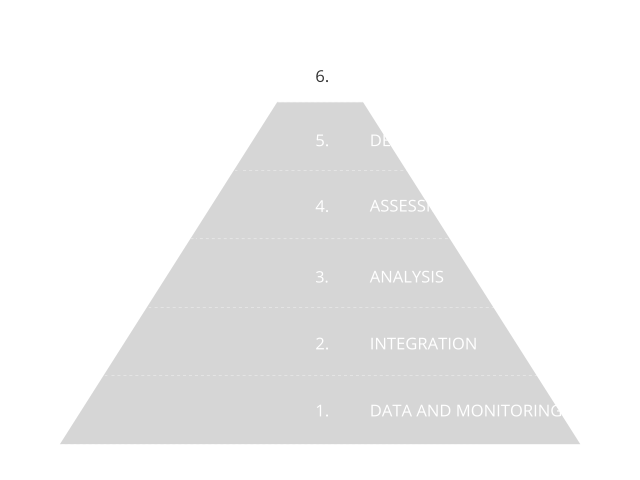
Environmental indicators are based on graphs, maps and assessments and as such present environmental trends in Slovenia. The indicators represent one of the four pillars of our environmental reporting, and are prepared in accordance with the Environmental Protection Act. The Environmental Indicators in Slovenia website enables users to browse among 180 indicators. They are based on numerical data and they indicate the state, characteristics and trends of environmental development in Slovenia. They are prepared using a systematic approach based on data and monitoring, as shown in the information pyramid.

Did you know?

Good

The Slovenian EHVZ database (Hydrography and Water Land Records) contains 67.549 watercourses with total length of 41.071 km. Total area of still waters is 24 km2 and river reservoirs 31 km2.

For use in water management, water land areas are delineated. Total area of water land in Slovenia is 387 km2, which is 1, 9 % of continental area of the Republic of Slovenia. Marine water land area is 214 km2.

Neutral

In 2024, net greenhouse gas emissions in the European Union were 2.3% lower than in 2023 and 38.0% lower than in 1990. In Slovenia, greenhouse gas emissions excluding the Land Use, Land-Use Change and Forestry (LULUCF) sector increased by 4.1% compared with 2023. Emissions from non-ETS sectors were 1.8% higher in 2024 than in 2023, but still 12.1% lower than in 2005.

Neutral
Sea

In the period 1961–2024, the mean annual sea level along the Slovenian coast increased. The mean annual sea level at the Koper tide gauge station reached 233 cm in 2024 and was the second highest in the comparative period 1991–2020. The highest annual sea level of 322 cm represented the third highest sea level after 1991, while the lowest annual sea level of 142 cm was the second highest among the lowest recorded sea levels after 1991.

Neutral

The above-average water-abundant years of 2013 and 2014 were followed by the below-average year of 2015 and the average water-abundant years of 2016–2021. The year 2022 was below-average, the year 2023 was above-average, and the year 2024 was slightly above-average. According to the annual river balance, in the period 1961–2024, the years 2010, 2013, 2014, and 2023 were significantly above average, while the years 1983, 2003, 2007, 2011, 2015, and 2022 were below average. The trend in river water run-off from the Slovenian territory is decreasing.

Bad

The frequency and intensity of groundwater droughts in alluvial aquifers have been increasing in recent decades. 8 out of 10 driest years in the 1981-2025 period occurred after year 2000. Higher intensity droughts generally occur in winter while milder droughts are characteristics of autumn. However, in the Primorska region and Ljubljana basin, extreme droughts predominately occur in summer. An increasing trend in extreme drought intensity is evident between June and September, coinciding with periods of peak water demand.

Good

The preference index for energy-saving household appliances among Slovenian households is a high 83 (on a scale from 0 to 100), which clearly shows the market is in a mature phase and its potential has been largely realized. This is also reflected in the consumer segmentation: on one hand, we find that nearly a quarter are " Energetic Catalysts" who have already fully upgraded their appliances, while on the other, there is only a smaller group of "Passive" and "Restrained" consumers.