KAZALCI OKOLJA

Environmental indicators in Slovenia


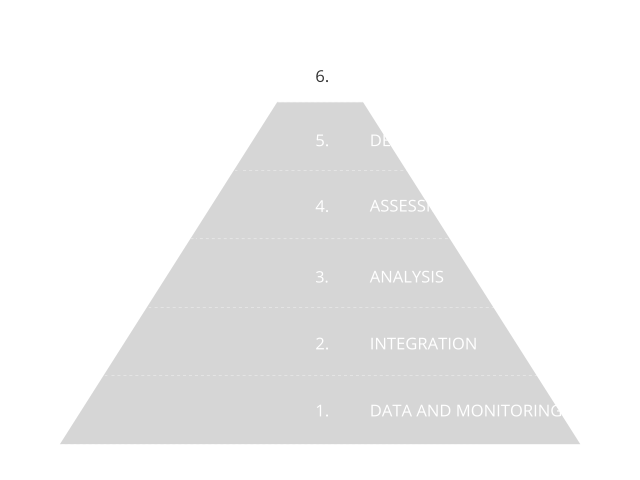
Environmental indicators are based on graphs, maps and assessments and as such present environmental trends in Slovenia. The indicators represent one of the four pillars of our environmental reporting, and are prepared in accordance with the Environmental Protection Act. The Environmental Indicators in Slovenia website enables users to browse among 180 indicators. They are based on numerical data and they indicate the state, characteristics and trends of environmental development in Slovenia. They are prepared using a systematic approach based on data and monitoring, as shown in the information pyramid.

Did you know?

Good

More than half of households in Slovenia have already used financial incentives for energy efficiency and renewable energy sources or are actively considering it. The index of household preferece for financial incentives offered by the Eco Fund increased positively by 4 index points from 2019 to 2022, when it was 52 on a scale from 0 to 100. Preference for these financial incentives varies between regions. On the one hand, knowledge and interest in the Eco Fund services is decreasing, while on the other hand, the share of households that have opted for these services again is increasing.

Neutral

The analysis of soil fertility with plant-available phosphorus (P₂O₅) and potassium (K₂O) shows substantial differences among land-use types. On arable land, phosphorus supply is insufficient in 39% of samples, adequate in 34%, and excessive in 27%. In permanent crops, P₂O₅ levels are evenly distributed across all fertility classes, reflecting diverse management and fertilization practices. The most pronounced phosphorus deficiency is observed in permanent grasslands, where as much as 78% of soils have insufficient phosphorus content.

Neutral

Greenhouse gas emissions from agriculture decreased by 20.5% between 1986 and 2023. The largest declines occurred in pig and cattle production and in fertilizer application to agricultural crops. The rapid decline in emissions was typical of the early years of this period until 2013. From 2013 to 2016, emissions increased and then remained at a similar level until 2021, after which they decreased significantly. Slovenia achieved the target in 2023. Compared to 2005, emissions decreased by 7.4%.

Neutral

In Slovenia, the majority of energy consumption in agriculture is gas oil used as a propellant for agricultural machinery (59.0%), followed by energy for the production of mineral nitrogen fertilizers (34.7%) and electric energy (3.7%). Gas oil consumption has not changed significantly in the last ten years. Electricity consumption for storage is mainly influenced by the amount of fruit.

Good

Sustainable mobility planning at both local and regional levels is rapidly gaining importance in Slovenia. Following the country’s accession to the EU and its related incentives, this approach began to take hold, and in the past decade it has made significant progress. An increasing number of municipalities and regions are responding to the encouragement of the EU and the competent ministry in Slovenia by developing and implementing Sustainable Urban Mobility Plans (SUMPs), which are the key instruments of mobility planning.

Good

The area of land involved in the implementation of agri-environmental measures increased by 49% between 2015 and 2022, most notably at the beginning of the programming period. The share of this land in the total utilised agricultural area (UAA) thus rose from around 14% to approximately 20% of all UAA.