KAZALCI OKOLJA

Environmental indicators in Slovenia


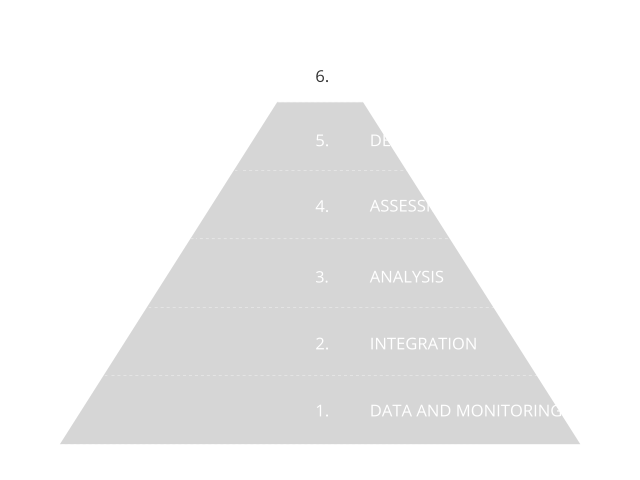
Environmental indicators are based on graphs, maps and assessments and as such present environmental trends in Slovenia. The indicators represent one of the four pillars of our environmental reporting, and are prepared in accordance with the Environmental Protection Act. The Environmental Indicators in Slovenia website enables users to browse among 180 indicators. They are based on numerical data and they indicate the state, characteristics and trends of environmental development in Slovenia. They are prepared using a systematic approach based on data and monitoring, as shown in the information pyramid.

Did you know?

Good

In the past centuries, forest area has been increasing constantly after 2010; however, the rate of expansion has slowed down and remains relatively stable in recent years. Since 1875, when forests covered only 36% of the Slovenian territory, forest cover has increased to 58.5% in the year 2009 and rests stable today at 58.0 %. In terms of forest share, Slovenia ranks third among EU-28 countries, behind Sweden and Finland.

Bad

The share of renewable energy sources (RES) in the use of fuels in industry amounted to 12,8% in 2023, which was 3.6 percentage points behind the annual indicative target value. The 2023 indicative target was thus not achieved. In order to achieve the target of 30% of RES in the use of fuels in industry in 2030, the share of RES will have to increase by 18 percentage points or by about approximately 3 percentage points per year.

Bad

In 2024, the amount of incentives for the implementation of measures related to energy efficiency (EE) and renewable energy sources (RES) in non-ETS industry amounted to EUR 1.1 million, i.e. 18 % less than the previous year. Only Eco Fund incentives are considered in this amount, as the projects co-financed under the Operational Programme for the Implementation of the European Cohesion Policy in the 2014–2020 Period (OP ECP) were not prepared in such a way that the monitoring of effects related to climate targets would be possible.

Bad

In 2024, the leverage of incentives in the public sector amounted to 54.6 euro cents of subsidy for 1 euro of investment. Compared to the previous year, when the leverage of incentives of 30.1 euro cents was the most favourable in the observed period, 24.5 euro cents more subsidy had to be allocated for 1 euro of investment. The increase was due to the implementation of investments under the Recovery and Resilience Plan (RRP), where the leverage of incentives was 98.8 euro cents of subsidy per 1 euro of investment.

Bad

In 2024, 118,700 m2 of total floor area of public sector buildings were renovated within the cohesion policy programs, and in the period 2021–2024, 548,200 m2 or 60% of the value planned in the Long-term strategy for energy renovation of buildings by 2050. Within the OP EKP 1.08 million m2 of total floor area were renovated by the end of 2024, which is at the level of the OP EKP target value. For the energy renovation of buildings owned and occupied by the central government the gap behind the target from OP EKP was significant.

Neutral

By 2024, the implementation of energy efficiency (EE) and renewable energy source (RES) measures in the public sector resulted in a cumulative energy savings of 358 GWh, and the cumulative CO2 emissions reduction was 87 kt. The 2020 target values were only achieved in 2023 and 2022. The gap is largely due to the insufficient intensity of investments in 2016 and 2017. The transition from one financial perspective to the other is expected to be visible also in 2025. No 2030 targets have been set for this indicator.