KAZALCI OKOLJA

Environmental indicators in Slovenia


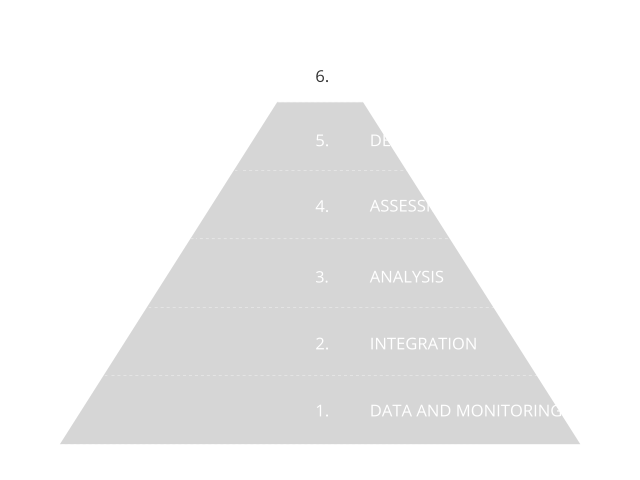
Environmental indicators are based on graphs, maps and assessments and as such present environmental trends in Slovenia. The indicators represent one of the four pillars of our environmental reporting, and are prepared in accordance with the Environmental Protection Act. The Environmental Indicators in Slovenia website enables users to browse among 180 indicators. They are based on numerical data and they indicate the state, characteristics and trends of environmental development in Slovenia. They are prepared using a systematic approach based on data and monitoring, as shown in the information pyramid.

Did you know?

Good

In 2022, greenhouse gas (GHG) emissions from sources according to the Regulation (EU) 2018/842 increased by 3.2% compared to the previous year, but in 2023 they decreased by 4.4% and were 7% below the annual target set by Regulation, thus achieving the indicative annual value. The 2030 target set by the National Energy and Climate Plan from 2020 (NECP 2020) is more ambitious and in 2023 the indicative annual value set by the NECP 2020 was not achieved, lagging behind by 0.5 percentage points.

Bad

Trends in annual precipitation are not as obvious as temperature trends. Changes between years and differences between regions are significant. According to climate change projections, annual precipitation will increase slightly while changes in seasonal precipitation will be more noticeable. Summer conditions are the most worrying, because less precipitation and higher temperature might result in higher frequency of droughts. In winter, more precipitation may lead to an increase in flooding events.

Neutral

Tourism in Slovenia is growing steadily. It was particularly high in the last five years before the pandemic, when Slovenia established itself as an attractive green destination. In 2021 and 2022, domestic guest arrivals and overnight stays increased due to the pandemic. In 2024, Slovenian tourism already exceeded the global and European average with an 8% increase in foreign arrivals compared to 2019.

Good

Net greenhouse gas (GHG) emissions in the land use, land use change, and forestry (LULUCF) sector amounted to -4.291 kt CO2 eq. in 2023. In this year, net sinks were 1.7% higher compared to the previous year and 40% lower compared to 2005. According to the Slovenian Forest Service, felling in 2024 was 7% higher than in 2023. In 2024, the share of sanitary felling was around 45% of the total annual felling, which means that it has increased slightly again.

Bad

GHG emissions in industry decreased by 7,1% in 2023 compared to the previous year. Since 2019, a trend of decreasing GHG emissions has been observed in this sector, mainly due to the reduction of GHG emissions in the ETS subsector of the industry sector.

Bad

Final energy consumption in buildings amounted to 1,477 ktoe in 2023 and was 4% lower than the indicative target value from the National Energy and Climate Plan from 2020 (NECP 2020). Compared to the previous year, it remained at approximately the same level, and compared to 2005, it decreased by 23%. Greenhouse gas (GHG) emissions in buildings amounted to 1,024 kt CO2 eq. in 2023, thus the indicative target value, which is the same in the NECP 2020 and in its update from 2024 (NECO 2024) was not achieved.