KAZALCI OKOLJA

Environmental indicators in Slovenia


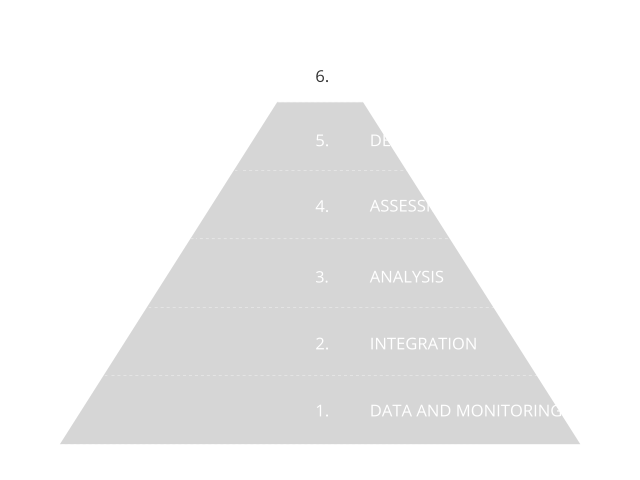
Environmental indicators are based on graphs, maps and assessments and as such present environmental trends in Slovenia. The indicators represent one of the four pillars of our environmental reporting, and are prepared in accordance with the Environmental Protection Act. The Environmental Indicators in Slovenia website enables users to browse among 180 indicators. They are based on numerical data and they indicate the state, characteristics and trends of environmental development in Slovenia. They are prepared using a systematic approach based on data and monitoring, as shown in the information pyramid.

Did you know?

Neutral

The rate of defoliation and forest decline in Slovenia was relatively stable until 2020, with a slightly negative trend. After 2020, a deterioration of tree defoliation was observed.

Neutral

Comparison of periods 1961–1990 and 1991–2020 on the chosen representative stations around Slovenia shows decrease of heating degree days by around 10 % and multiple increase of cooling degree days. With projected continuous temperature raise until the end of 21st century, those trends are expected to continue. Thus, in Slovenia, energy demand for cooling will increase in the warmer period of the year, while the energy demand for heating will decrease in colder period of the year. Same trend is projected for Europe in general.

Bad

Trends in annual precipitation are not as obvious as temperature trends. Changes between years and differences between regions are significant. According to climate change projections, annual precipitation will increase slightly while changes in seasonal precipitation will be more noticeable. Summer conditions are the most worrying, because less precipitation and higher temperature might result in higher frequency of droughts. In winter, more precipitation may lead to an increase in flooding events.

Bad

Among the statistical regions of Slovenia, the Osrednjeslovenska region has the highest ecological footprint per capita (5.8 gha), while the Goriška region has the lowest (4.79 gha). The largest share of the ecological footprint in all regions is represented by the carbon footprint, contributing approximately 60%. A significant portion is also attributed to forest products (around 20%) and agricultural land (around 10%). The region with the highest biocapacity per capita is Primorsko-notranjska (8.02 gha), while Osrednjeslovenska has the lowest (1.11 gha).

Neutral

Tourism in Slovenia is growing steadily. It was particularly high in the last five years before the pandemic, when Slovenia established itself as an attractive green destination. In 2021 and 2022, domestic guest arrivals and overnight stays increased due to the pandemic. In 2024, Slovenian tourism already exceeded the global and European average with an 8% increase in foreign arrivals compared to 2019.

Bad

GHG emissions in industry decreased by 7,1% in 2023 compared to the previous year. Since 2019, a trend of decreasing GHG emissions has been observed in this sector, mainly due to the reduction of GHG emissions in the ETS subsector of the industry sector.