KAZALCI OKOLJA

Environmental indicators in Slovenia


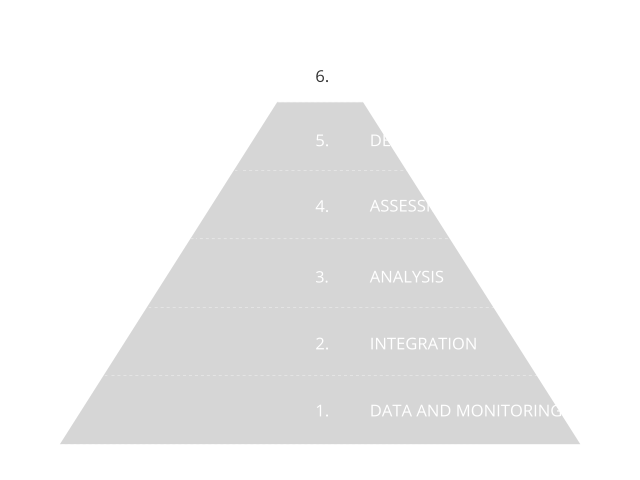
Environmental indicators are based on graphs, maps and assessments and as such present environmental trends in Slovenia. The indicators represent one of the four pillars of our environmental reporting, and are prepared in accordance with the Environmental Protection Act. The Environmental Indicators in Slovenia website enables users to browse among 180 indicators. They are based on numerical data and they indicate the state, characteristics and trends of environmental development in Slovenia. They are prepared using a systematic approach based on data and monitoring, as shown in the information pyramid.

Did you know?

Neutral

The export of waste from Slovenia decreased in 2020, for the first time after ten years of growth. We exported around 340 thousand tonnes of waste, mainly to Austria and Hungary. The import of waste also declined for the first time in 2020, we imported around 61 thousand tonnes of waste.

Good

In the past centuries, forest area has been increasing constantly after 2010; however, the rate of expansion has slowed down and remains relatively stable in recent years. Since 1875, when forests covered only 36% of the Slovenian territory, forest cover has increased to 58.5% in the year 2009 and rests stable today at 58.0 %. In terms of forest share, Slovenia ranks third among EU-28 countries, behind Sweden and Finland.

Neutral

In 2021, 62% of the population was connected to the municipal wastewater treatment systems with secondary or tertiary treatment, which do not produce GHG emissions. Compared to the previous year, the share decreased by a small percentage point, moreover, the share has remained almost unchanged since 2017.

Good

Energy efficiency in industry has improved significantly over the period 2005–2022, with a 39% increase. The sectors that have contributed the most to this were production of paper, machinery and equipment, chemical industry and production of non-ferrous metals, while the production of steel and non-metallic mineral products have contributed the least.

Neutral

The performance of EU countries in the field of eco-innovations is monitored by a composite index that includes 12 indicators from five thematic areas. Slovenia is ranked as an average eco-innovation performer. The values of the indicator are gradually improving and show the progress of the eco-innovation index, but they still remain below the EU average. The target value for Slovenia has not been set.

Good

In Slovenia, forests have been growing in terms of growing stock and increment for decades. They have increased by more than 140% over the last 70 years. In addition to natural conditions, harvesting depends on socioeconomic factors, and recently on the occurrence of natural disasters (windbreaks, icebreakers) and bark beetles outbreaks. By 2014, the felling accounted for about 50% of the increment. After the ice storm in 2014, it increased substantially and accounted for 60 to 75% of the total increment of conifers and deciduous trees.