KAZALCI OKOLJA

Environmental indicators in Slovenia


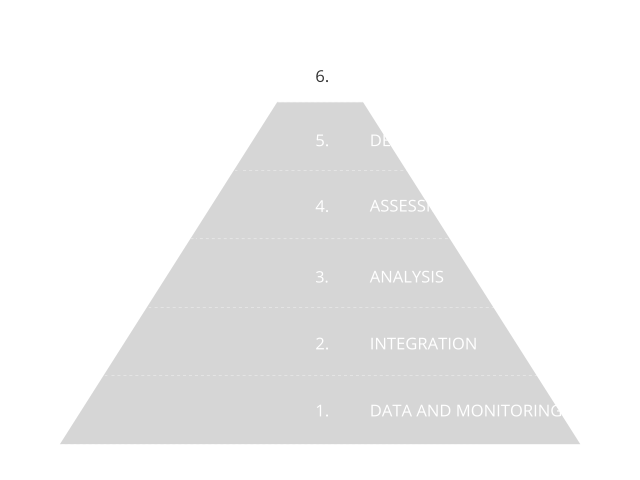
Environmental indicators are based on graphs, maps and assessments and as such present environmental trends in Slovenia. The indicators represent one of the four pillars of our environmental reporting, and are prepared in accordance with the Environmental Protection Act. The Environmental Indicators in Slovenia website enables users to browse among 180 indicators. They are based on numerical data and they indicate the state, characteristics and trends of environmental development in Slovenia. They are prepared using a systematic approach based on data and monitoring, as shown in the information pyramid.

Did you know?

Bad

In 2024, the amount of incentives for the implementation of measures related to energy efficiency (EE) and renewable energy sources (RES) in non-ETS industry amounted to EUR 1.1 million, i.e. 18 % less than the previous year. Only Eco Fund incentives are considered in this amount, as the projects co-financed under the Operational Programme for the Implementation of the European Cohesion Policy in the 2014–2020 Period (OP ECP) were not prepared in such a way that the monitoring of effects related to climate targets would be possible.

Good

Natura 2000 areas were designated in 2004. Acording to the conclusions of bilateral meeting with European Comission in 2014 the Natura 2000 network was expanded in 2016. Natura 2000 area cover 7681 km2 or 37,50% of the total area and 7676 km2 or 37,87 % of the terrestrial area of the country.

Good

Nutrients, especially nitrogen and phosphorus compounds, are important for the growth of algae and higher plants, but in high concentrations can cause undesirable changes in aquatic organisms and seawater quality. Long-term measurements of selected nutrients in the Slovenian sea show that their concentrations have decreased significantly. Therefore, the ecological status of the Slovenian Sea is assessed as good to very good based on nutrients in recent years.

Neutral

The number of inhabitants who live in the impact area of major roads outside urban areas has decreased. In 2017, around 16,000 fewer inhabitants were exposed to high noise levels throughout the day and during the night compared to 2012. In urban areas, the number of inhabitants who are exposed to road traffic noise has not decreased. The number of inhabitants who are exposed to high noise levels throughout the day has remained at the same level as in 2012 and is estimated at 64,000.

Neutral

The number of inhabitants who live in the impact area of major railways outside urban areas and are exposed to rail traffic noise has not changed significantly in the past years. In 2017, around 7,000 inhabitants were exposed to high noise levels throughout the day and around 10,700 inhabitants during the night. Between 2012 and 2017, the number of inhabitants who are exposed to high rail traffic noise did not decrease.

Good

The number of inhabitants who are exposed to high noise levels along major roads and railways in Maribor is gradually decreasing. In Maribor, in terms of inhabitants exposed, rail traffic is less significant noise source compared to road traffic, which is one of the most significant noise sources. It is estimated that approximately 16,400 inhabitants are exposed to high road traffic noise levels throughout the day.