KAZALCI OKOLJA

Environmental indicators in Slovenia


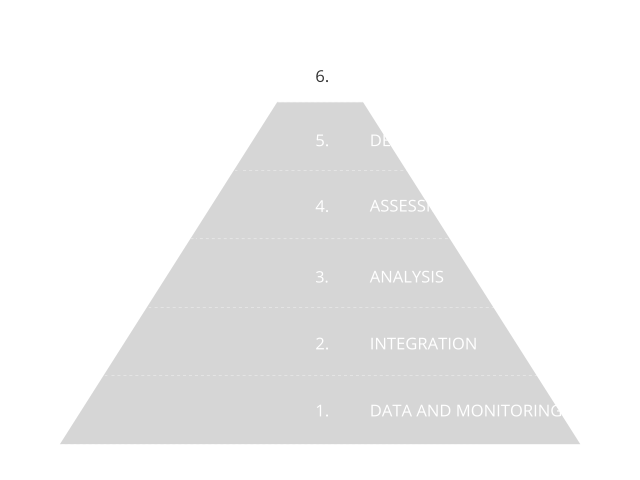
Environmental indicators are based on graphs, maps and assessments and as such present environmental trends in Slovenia. The indicators represent one of the four pillars of our environmental reporting, and are prepared in accordance with the Environmental Protection Act. The Environmental Indicators in Slovenia website enables users to browse among 180 indicators. They are based on numerical data and they indicate the state, characteristics and trends of environmental development in Slovenia. They are prepared using a systematic approach based on data and monitoring, as shown in the information pyramid.

Did you know?

Good

In Slovenia, slightly more than 106,000 tonnes of municipal waste were landfilled at 10 non-hazardous waste landfills in 2023, compared to slightly more than 90,000 tonnes the year before. The increase in landfilled municipal waste in 2023 was the result of the extensive floods that hit Slovenia during the summer of that year.

The share of landfilled municipal waste at the EU level in 2023 was 22% of generated municipal waste. The countries in which more than half of generated municipal waste was landfilled include Greece, Romania, Malta, Cyprus, Portugal, Hungary, and Bulgaria.

Neutral

By 2024, the implementation of energy efficiency (EE) and renewable energy source (RES) measures in the public sector resulted in a cumulative energy savings of 358 GWh, and the cumulative CO2 emissions reduction was 87 kt. The 2020 target values were only achieved in 2023 and 2022. The gap is largely due to the insufficient intensity of investments in 2016 and 2017. The transition from one financial perspective to the other is expected to be visible also in 2025. No 2030 targets have been set for this indicator.

Good

The cumulative final energy savings due to the implementation of energy efficiency (EE) and renewable energy source (RES) measures in the residential sector amounted to 1,130 GWh in the period 2021–2024, and the cumulative CO2 emissions reduction was 264 kt. Compared to the previous year, annual energy savings decreased by 3%, while the reduction in CO2 emissions increased by a good one percent, making it the highest in the observed period.

Good

Greenhouse gas (GHG) emissions due to land-use change generally show a declining trend. In 2023, GHG emissions from deforestation decreased by 1.5% compared to the previous year, with more than half, i.e. 62%, of these emissions coming from the establishment of agricultural land. GHG emissions due to land conversion to built-up and related land decreased by 2.7% compared to the previous year. The largest share of emissions (75%) is due to the conversion of agricultural land to built-up and related land.

Bad

Slovenian forests are over-mature, the current ratio of forest development phases is unfavourable, forest regeneration is too slow, or the areas of forests under restoration are too small to significantly change the share of forest development phases and thus ensure sustainable forest development. The role of forests as a carbon sink is at risk.

Neutral

Most Slovenian forests are still undergoing natural regeneration, which guarantees the stability of future forest stands and adaptation to the changing site conditions caused by climate change. Restoration by planting seedlings and sowing (artificial regeneration) only complements natural regeneration when disturbances occur in the process of the natural regeneration of the forest, e.g. where there is no possibility of natural seeding, with the risk of developing erosion processes on exposed forest areas (e.g.