KAZALCI OKOLJA

Environmental indicators in Slovenia


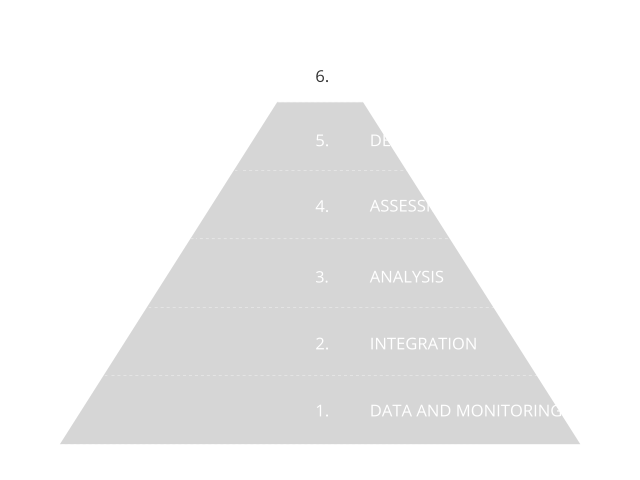
Environmental indicators are based on graphs, maps and assessments and as such present environmental trends in Slovenia. The indicators represent one of the four pillars of our environmental reporting, and are prepared in accordance with the Environmental Protection Act. The Environmental Indicators in Slovenia website enables users to browse among 180 indicators. They are based on numerical data and they indicate the state, characteristics and trends of environmental development in Slovenia. They are prepared using a systematic approach based on data and monitoring, as shown in the information pyramid.

Did you know?

Neutral

The number of available beds and of overnight stays, in particular, have been growing constantly during the period in question (1992-2009). Tourist bed occupancy rates were highest during the summer months, when the majority of tourists visit seaside tourist resorts, with a slightly smaller share visiting mountain and health resorts. During the winter season, health resorts record the highest number of overnight stays.

Neutral

The indicator monitors the economic, social and environmental dimensions of sustainable development by comparing the HDI - the human development index and the ecological footprint. Between 1990 and 2019, the value of the Human Development Index (HDI) increased from 0.774 to 0.917 (by 18.5%). Slovenia is ranked among the countries with a very high human development index, in 22nd place out of 189 countries included in the calculations. In general, the higher the HDI of a country is, the higher the ecological footprint is.

Neutral

Species diversity in Slovenia is stil considerably well preserved, distinctly higher in western part of the country. Without systematic monitoring on permanent plots it is impossible to recognize short term trends, but in some regions negative trends are result of landuse changes and impact of alien invasive species.

Bad

The share of present invasive species (eg. Robinia pseudacacia, Ailanthus altissima, Buddleja davidii, Erigeron annuus) in the last decade shows an increasing trend. An increase in the share of invasive species is evident along the great lowland rivers Sava, Mura and Drava, as well as along the Kolpa river. In higher areas of Slovenia, particularly in the Alps and the Dinaric region, invasive species are very few or entirely absent. However, a notable increase in their share along the western border of the Dinaric region raises concerns.

Good

Designated areas, which include Natura 2000 and protected areas, cover 40% of the total area of the country, which is almost six times more than in 1992. The increase in designated areas is due to designation of Natura 2000 network in 2004 and more landscape parks from 2008 until 2019. For any planned construction activity on designated areas a nature conservation consent is needed.

Bad

The results of the Energy Efficiency Survey of Slovenia - REUS show that the share of Slovenian households that are ready to start using or increase their use of public transport over the next 12 months remains quite small – a trend has not significantly changed during the 2011-2019 period. The data show that almost a tenth of households are ready, while a quarter of households are considering the option, while more than two thirds are not ready to start using or to increase their use of public transport.