KAZALCI OKOLJA

Environmental indicators in Slovenia


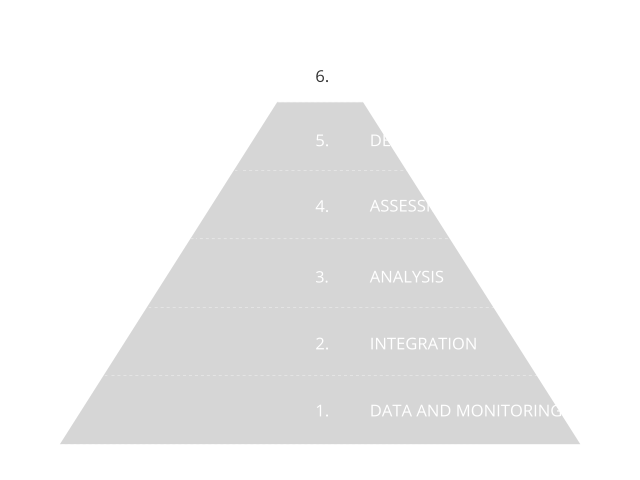
Environmental indicators are based on graphs, maps and assessments and as such present environmental trends in Slovenia. The indicators represent one of the four pillars of our environmental reporting, and are prepared in accordance with the Environmental Protection Act. The Environmental Indicators in Slovenia website enables users to browse among 180 indicators. They are based on numerical data and they indicate the state, characteristics and trends of environmental development in Slovenia. They are prepared using a systematic approach based on data and monitoring, as shown in the information pyramid.

Did you know?

Neutral

The number of inhabitants who live in the impact area of major roads outside urban areas has decreased. In 2017, around 16,000 fewer inhabitants were exposed to high noise levels throughout the day and during the night compared to 2012. In urban areas, the number of inhabitants who are exposed to road traffic noise has not decreased. The number of inhabitants who are exposed to high noise levels throughout the day has remained at the same level as in 2012 and is estimated at 64,000.

Neutral

According to the short-term projection, ESR emissions in 2025 were 0.6% higher than actual emissions in 2024. The difference can be attributed mainly to the industry and transport sectors, and to a lesser extent to the electricity and heat production and consumer goods sectors. Compared to the annual target for 2025 under Regulation (EU) 2023/857, emissions were higher by 318 kt CO2 eq. or 3.1%, and compared to the indicative annual value from the NECP 2024, they were higher by 934 kt CO2 eq. or 9.7%.

Neutral

According to the projection based on existing measures, total greenhouse gas (GHG) emissions will remain at a level similar to today's until 2030 and will then begin to decline. Under the projection that includes additional measures, however, emissions will decrease dramatically – by 35% by 2030 and by 88% by 2050. The projections indicate that, with the intensive implementation of measures, it is possible to achieve the targets set for reducing total GHG emissions, as well as emissions from sources not covered by the Emissions Trading System (ETS).

Good

Slovenia has a relatively high level of energy intensity, although it has been declining, particularly rapidly in recent years. Between 2005 and 2023, energy intensity decreased at an average annual rate of 3.2%. In 2024, energy intensity increased for the first time since 2016, rising by 2.1%. In 2024, Slovenia’s energy intensity was 37% higher than the EU-27 average, which is 15 percentage points less than in 2005.

Bad

In 2024, the share of RES in transport, after an increase in 2023, dropped again and amounted to 9,2%. With this, it was 1,6 percentage points behind the non-binding 2024 target from the updated National Energy and Climate Plan (NECP 2024).

Neutral

Final energy consumption in 2024 amounted to 4,594 ktoe and increased by 2.4% compared to the previous year. A decrease occurred only in households, by 1.6%; in all other sectors, final energy consumption increased: by less than one per cent in industry, by 2.8% in services, and the most, by 5.3%, in transport. Final energy consumption was 177 ktoe (- 3.7%) , or 3.7%, lower than the 2024 indicative target value from the National Energy and Climate Plan from 2020 (NECP 2024). The indicative annual target was thus achieved.