KAZALCI OKOLJA

Environmental indicators in Slovenia


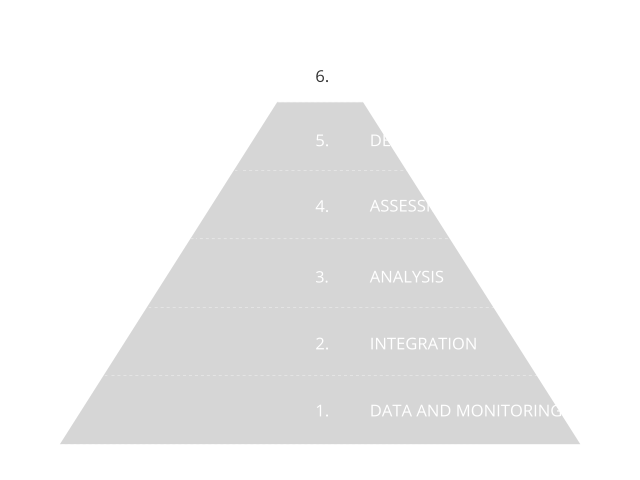
Environmental indicators are based on graphs, maps and assessments and as such present environmental trends in Slovenia. The indicators represent one of the four pillars of our environmental reporting, and are prepared in accordance with the Environmental Protection Act. The Environmental Indicators in Slovenia website enables users to browse among 180 indicators. They are based on numerical data and they indicate the state, characteristics and trends of environmental development in Slovenia. They are prepared using a systematic approach based on data and monitoring, as shown in the information pyramid.

Did you know?

Good

In 2023, around 182 million pieces of plastic carrier bags were placed on the Slovenian market, of which 99% were those with a wall thickness of less than 50 microns (light plastic carrier bags). In Slovenia, the consumption of lightweight plastic carrier bags amounted to 85 bags per capita in 2023 In the same year, 145.9 million pieces of single-use food containers made wholly or partly of plastic and 174.4 million pieces of single-use beverage cups made wholly or partly of plastic were placed on the Slovenian market.

Neutral

One of the main reasons of mortality due to respiratory diseases is in Slovenia chronic pulmonary disease (COPD). The highest mortality rate due to respiratory diseases in Slovenia is in Podravska and Pomurska region and the lowest in Central-Slovenian region (2022–2024). Mortality due to respiratory diseases is decreasing; in the period 2017 to 2021 it decreased from 62/100.000 inhabitants to 43/100.000 inhabitants in the year 2024. This can be attributed to the “harvesting effect” of COVID 19.

Neutral

Nutrient over-enrichment remains the key environmental challenge for lakes and reservoirs in Slovenia. For the assessment period 2014–2019, only 4 of the 11 lake water bodies achieved good or high ecological status. Recent annual data indicate no signs of improvement, and in some lakes total phosphorus concentrations are even rising. The main pressures are linked to human activities, especially inappropriate discharge of municipal wastewater, intensive agriculture in the catchments, and fisheries.

Neutral

The values ​​of the parameters used to monitor the load of rivers with organic substances have decreased significantly since 1996. The observed decrease in organic load corresponds to the increase in the proportion of the population whose wastewater is treated in municipal and joint wastewater treatment plants. The load of rivers with nutrients varies significantly between river basins. The average nitrate values ​​in all river basins of the Danube river basin are higher than in the Soča and Adriatic river basins and above the values of the natural background.

Good
Sea

The quality of bathing water along the Slovenian coast is excellent, which ranks Slovenia at the top among the EU countries.

Good

The quality of inland bathing waters in Slovenia is high, as most are classified as “excellent”, which is better than in the majority of other EU Member States.