KAZALCI OKOLJA

Environmental indicators in Slovenia


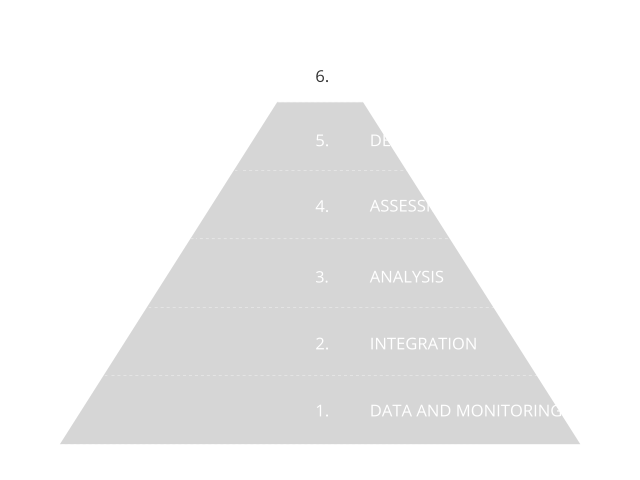
Environmental indicators are based on graphs, maps and assessments and as such present environmental trends in Slovenia. The indicators represent one of the four pillars of our environmental reporting, and are prepared in accordance with the Environmental Protection Act. The Environmental Indicators in Slovenia website enables users to browse among 180 indicators. They are based on numerical data and they indicate the state, characteristics and trends of environmental development in Slovenia. They are prepared using a systematic approach based on data and monitoring, as shown in the information pyramid.

Did you know?

Good

In Slovenia, a major forest fire occurs approximately every five years over the long term, which leads to relatively high greenhouse gas emissions in these years. The highest GHG emissions from forest fires since the data was recorded were in 2022, when more than 3,000 ha of forest burned in the Goriški Kras. With higher temperatures, droughts and more frequent heatwaves, the risk of fire is likely to increase, leading to greater uncertainty and more frequent emission peaks.

Good

Energy efficiency in industry improved significantly between 2005 and 2023, with a 43% increase in 2023 compared to 2005. The chemical industry, machinery and equipment manufacturing, non-ferrous metals, and paper manufacturing contributed the most to the improvement, while steel production and non-metallic mineral products contributed the least.

Neutral

Over the past decade, Slovenia has significantly improved its Eco-Innovation Index, mainly due to the growth in scientific publications, but it still remains slightly below the EU average, as the number of patents and exports of environmental goods and services has declined. Despite this progress, the gap with the EU stood at 4.7% in 2024.

Index includes 12 indicators from five thematic areas. Slovenia is ranked as an average eco-innovation performer. The target value for Slovenia has not been set.

Bad

With the increasing share of electric passenger vehicles, CO2 emissions decreased in 2022 and 2023, but increased slightly in 2024 compared to the previous year due to the decrease in the share. The gap to the target value is almost 34%.

The average emissions of all passenger vehicles increased in 2022 compared to the previous year. In 2023, the average emissions decreased back to approximately the level of 2021. The target values were not achieved.

Neutral

Total greenhouse gas emissions are projected to remain at similar levels as today until 2030 under projection with existing measures, then decline. Under projection with additional measures emissions will decline faster. By 35% by 2030 and by 88% by 2050. Projections show that with intensive implementation of measures, it is possible to achieve the set targets.

Bad

The intensity of GHG emissions from fuels and energy in transport in Slovenia was 4.7% lower than the baseline in 2021, which is 1.3 percentage points below the target reduction. Although the intensity is decreasing, the pace is too slow. The largest contribution to reducing intensity comes from the blending of biofuels. In the EU, the largest reductions were achieved by Sweden and Finland, along with 11 other countries that achieved reductions of 6% or more.