KAZALCI OKOLJA

Environmental indicators in Slovenia


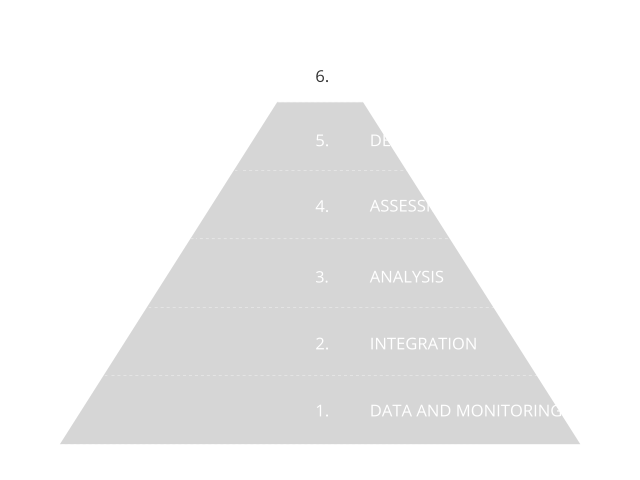
Environmental indicators are based on graphs, maps and assessments and as such present environmental trends in Slovenia. The indicators represent one of the four pillars of our environmental reporting, and are prepared in accordance with the Environmental Protection Act. The Environmental Indicators in Slovenia website enables users to browse among 180 indicators. They are based on numerical data and they indicate the state, characteristics and trends of environmental development in Slovenia. They are prepared using a systematic approach based on data and monitoring, as shown in the information pyramid.

Did you know?

Good

In the past centuries, forest area has been increasing constantly after 2010; however, the rate of expansion has slowed down and remains relatively stable in recent years. Since 1875, when forests covered only 36% of the Slovenian territory, forest cover has increased to 58.5% in the year 2009 and rests stable today at 58.0 %. In terms of forest share, Slovenia ranks third among EU-28 countries, behind Sweden and Finland.

Bad

Frequency of groundwater drought is increasing in recent decades in alluvial aquifers. 8 out of 10 years with highest intensity of groundwater drought in period 1981-2024 occurred after year 2000. Groundwater droughts with higher intensity is characteristic for winter while milder groundwater droughts mostly occur at autumn. Groundwater drought intensity is also increasing seasonally with time between June and September when groundwater use is pronounced.

Bad

In Slovenia and in other European countries the proportion of vehicle fleet that comply with the latest and most stringent emission standards increased sharply in period 2011-2020. Penetration of new technology is highest for the diesel cars.

Bad

The ownership of passenger cars, closely linked to their usage, has been steadily increasing in Slovenia for a long time – it has doubled since the country's independence in 1991. Between 2008 and 2015, car ownership grew more slowly due to the economic recession, but since 2015, the growth has accelerated again. The exceptions were the pandemic years of 2020 and 2021. Slovenia's motorization rate (measured in the number of personal cars per thousand inhabitants) exceeds the EU average and is higher than that of many economically more developed EU countries.

Bad

Greenhouse gas (GHG) emissions from transport in Slovenia almost tripled between 1986 and 2022. In the EU, GHG emissions from transport also exceed economic growth on average, but significantly less than in Slovenia; in the period 1990-2022, they increased by a quarter in the EU-28. The main source of GHG is mostly road transport, which contributes as much as 99% of all GHG emissions from transport. The majority share of traffic emissions in Slovenia in total GHG emissions and insufficiently effective measures to reduce them hinder Slovenia's efforts to achieve the accepted obligations.

Neutral

The indicator mainly shows the unidentifiable direction of development. The majority of data were available only for a limited period, and therefore, reliable estimation of trends is not possible. Cereals are the predominant group of crops in Slovenia. Areas for growing green fodder crops and industrial plants are increasing, while the production of root and tuber crops has stabilized on two percent of arable land. A slow diversification of crop types is noticeable, with a positive trend in the share of legumes, although this share has stabilized at around 15% in recent years.