KAZALCI OKOLJA

Environmental indicators in Slovenia


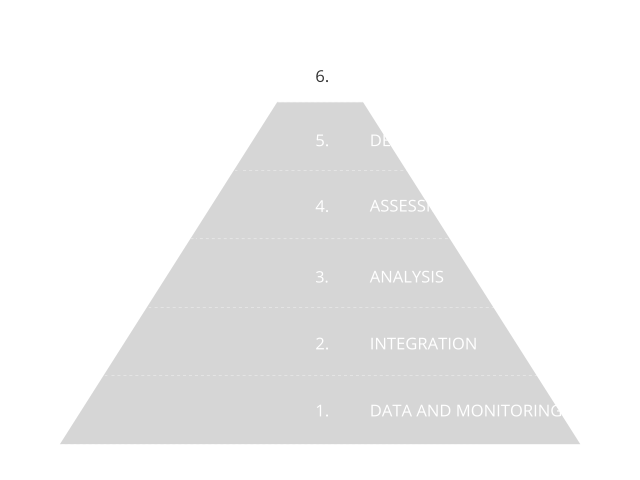
Environmental indicators are based on graphs, maps and assessments and as such present environmental trends in Slovenia. The indicators represent one of the four pillars of our environmental reporting, and are prepared in accordance with the Environmental Protection Act. The Environmental Indicators in Slovenia website enables users to browse among 180 indicators. They are based on numerical data and they indicate the state, characteristics and trends of environmental development in Slovenia. They are prepared using a systematic approach based on data and monitoring, as shown in the information pyramid.

Did you know?

Good

In Slovenia, slightly more than 106,000 tonnes of municipal waste were landfilled at 10 non-hazardous waste landfills in 2023, compared to slightly more than 90,000 tonnes the year before. The increase in landfilled municipal waste in 2023 was the result of the extensive floods that hit Slovenia during the summer of that year.

The share of landfilled municipal waste at the EU level in 2023 was 22% of generated municipal waste. The countries in which more than half of generated municipal waste was landfilled include Greece, Romania, Malta, Cyprus, Portugal, Hungary, and Bulgaria.

Bad

The most of energy in transport is used in cars, followed by trucks, the share of which is growing very fast. Efficiency of energy use with excluded influence of transit transport is improving, but too slow.

Good

The most of energy in households is used for heating of appartments. In the period 2009-2012, efficiency of energy use increased a lot, especially on the account of increase of efficiency of energy used for heating.

Neutral

In Slovenia 7 % of people live in flood-prone areas. The most extensive flood areas are in northeast and in subpannonian Slovenia, in subalpine valleys and basins and plains along Ledava, Mura and Ščavnica. The largest share of the population in areas of flooding is in Savinjska (13%), Koroška (12%), Zasavska, (10%) and Osrednjeslovenska (9%) statistical region.

Neutral

In Slovenia the concentration of dioxins in human milk is low and comparable to those in the neighboring countries. Long-term surveillance will be possible once regular national human biomonitoring is established and assured.

Bad

In 2011 continued the dominance of solid fuels for the production of electricity, which has been available for use in Slovenia, but the share is slowly decreasing. Followed by renewable energy sources to 30% share and of nuclear energy has been produced 24% of electricity. The share of electricity produced from domestic sources was 80% above the target set by the Resolution of the National Energy Program.