KAZALCI OKOLJA

Environmental indicators in Slovenia


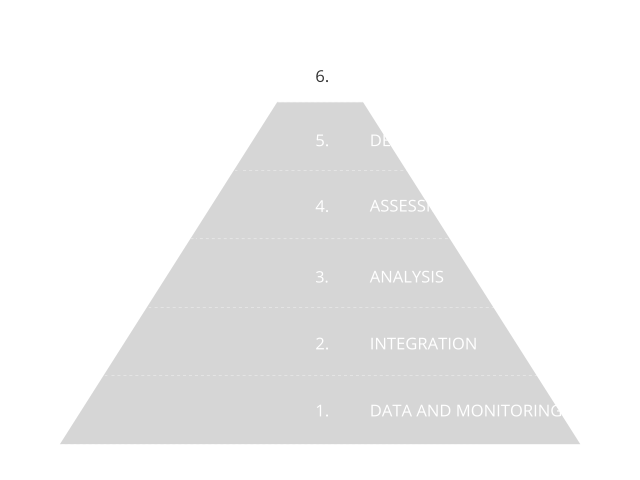
Environmental indicators are based on graphs, maps and assessments and as such present environmental trends in Slovenia. The indicators represent one of the four pillars of our environmental reporting, and are prepared in accordance with the Environmental Protection Act. The Environmental Indicators in Slovenia website enables users to browse among 180 indicators. They are based on numerical data and they indicate the state, characteristics and trends of environmental development in Slovenia. They are prepared using a systematic approach based on data and monitoring, as shown in the information pyramid.

Did you know?

Neutral

Energy efficiency in transport is improving, but too slowly, as it improved by only 11% in the period 2000-2019. Most of the energy in traffic is consumed in passenger cars, where efficiency has deteriorated.

In households, energy efficiency improved by 33% over the same period, mainly due to an improvement in energy efficiency for heating. Most energy in households is used to heat homes.

Good

The preference index for energy-saving household appliances among Slovenian households is a high 83 (on a scale from 0 to 100), which clearly shows the market is in a mature phase and its potential has been largely realized. This is also reflected in the consumer segmentation: on one hand, we find that nearly a quarter are " Energetic Catalysts" who have already fully upgraded their appliances, while on the other, there is only a smaller group of "Passive" and "Restrained" consumers.

Neutral

Large majority of registered passenger cars are still powered by conventional fuels (gasoline and diesel).  Although the total share of alternative-fuel vehicles tripled in the period from 2019 to 2025, it still remains very small.

Neutral

The results of the REUS 2025 survey show that the willingness of Slovenian households to use alternative means of transport is increasing. Despite this, the personal car remains the absolutely dominant form of transport, and its use over shorter distances is even strengthening. The main reason for this is undoubtedly the large gap between users' wishes and the actual quality of public transport. The main reasons for not using public transport remain the same as in the past: poor connections, being too time-consuming, and inadequate schedules.

Neutral

The indicator “Public Awareness on Energy Efficiency” shows that awareness of energy efficiency is high among Slovenian households, but the motivation for it has been changing significantly. Household decisions on energy efficiency have been increasingly driven by finances in recent years, while the environmental aspect is losing importance as an equivalent factor.

Neutral

The REUS 2025 survey reveals that the share of newly registered electric and hybrid vehicles has grown strongly, representing almost a third (32%) of all new vehicle registrations in 2024, which is eight times more than in 2019. However, their share among all passenger vehicles reaches a modest 6%. When purchasing an alternative-powertrain vehicle, households opt for hybrids (26%) much more often than for fully electric models (6%), which is likely a result of more favorable prices and less dependence on charging infrastructure.