KAZALCI OKOLJA

Environmental indicators in Slovenia


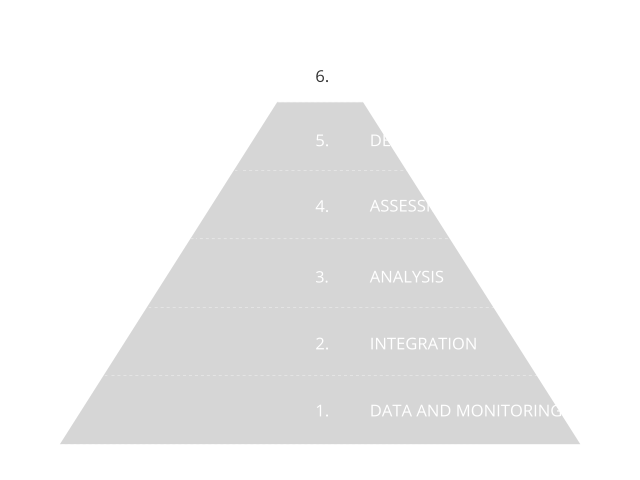
Environmental indicators are based on graphs, maps and assessments and as such present environmental trends in Slovenia. The indicators represent one of the four pillars of our environmental reporting, and are prepared in accordance with the Environmental Protection Act. The Environmental Indicators in Slovenia website enables users to browse among 180 indicators. They are based on numerical data and they indicate the state, characteristics and trends of environmental development in Slovenia. They are prepared using a systematic approach based on data and monitoring, as shown in the information pyramid.

Did you know?

Neutral

Due to high lead content in the environment, the Upper Meža Valley area was declared a brownfield site area in 2007 and underwent special remediation measures with the aim of protecting the health of people, especially children. Data shows that the lead exposure of children in the Upper Meža Valley improved rapidly in the early years of implementing the remediation measures, but no further improvement was observed after 2010. A prevalence study of lead levels in children's blood from the Meža Valley in 2018 even showed higher values compared to a study conducted in 2013.

Good

In Slovenia, forests have been growing in terms of growing stock and increment for decades. They have increased by more than 140% over the last 70 years. In addition to natural conditions, harvesting depends on socioeconomic factors, and recently on the occurrence of natural disasters (windbreaks, icebreakers) and bark beetles outbreaks. By 2014, the felling accounted for about 50% of the increment. After the ice storm in 2014, it increased substantially and accounted for 60 to 75% of the total increment of conifers and deciduous trees.

Good

Forests in Slovenia are relatively well preserved, especially in terms of the diversity of the natural tree species composition and the vertical and horizontal stand structure. The share of preserved forests exceeds 50%. Heavily modified, mostly forests where natural tree species are altered with spruce, and altered forests make up just over a tenth of all forests.

Neutral

Areas of fields and gardens in measures that require fertilization based on rapid soil or plant tests have significantly exceeded the target value set by the 2014–2020 Rural Development Programme.

Good

In the period after 2000, nitrogen consumption from mineral fertilisers initially declined. After 2009, consumption more or less stabilised at around 27,500 tonnes, with annual values ranging from 26,300 to 29,143 tonnes. With the exception of 2021, the target value (< 28,000 t) has been achieved in recent years. The increase in 2021 was probably the result of purchases of mineral fertilizers for stock, which were made due to expected price increases and supply disruptions.

Good

In the period 2005–2022, the land area in the organic farming measure more than doubled (from 20,477 to 50,540 ha). The target set by the Operational Programme for Reducing GHG Emissions until 2020 (OP GHG) for 2020 (44,000 ha) was already exceeded in 2018. The new targets of the Strategic Plan of the Common Agricultural Policy 2023–2027 are significantly more ambitious, and the past trends show that achieving them will be very challenging.