KAZALCI OKOLJA

Environmental indicators in Slovenia


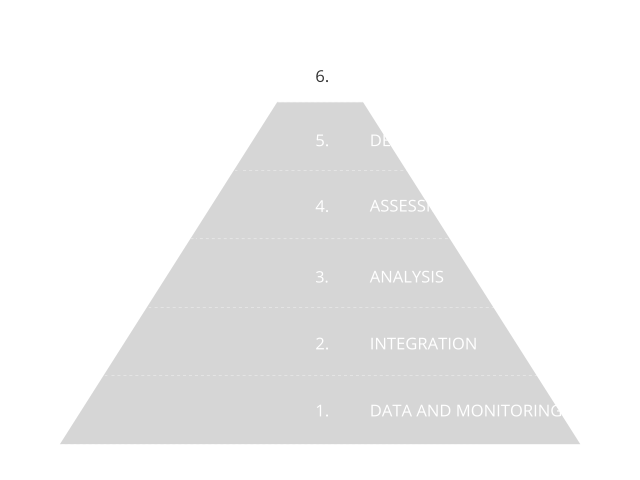
Environmental indicators are based on graphs, maps and assessments and as such present environmental trends in Slovenia. The indicators represent one of the four pillars of our environmental reporting, and are prepared in accordance with the Environmental Protection Act. The Environmental Indicators in Slovenia website enables users to browse among 180 indicators. They are based on numerical data and they indicate the state, characteristics and trends of environmental development in Slovenia. They are prepared using a systematic approach based on data and monitoring, as shown in the information pyramid.

Did you know?

Bad

With the increasing share of electric passenger vehicles, CO2 emissions decreased in 2022 and 2023, but increased slightly in 2024 compared to the previous year due to the decrease in the share. The gap to the target value is almost 34%.

The average emissions of all passenger vehicles increased in 2022 compared to the previous year. In 2023, the average emissions decreased back to approximately the level of 2021. The target values were not achieved.

Good
Sea

The quality of bathing water along the Slovenian coast is excellent, which ranks Slovenia at the top among the EU countries.

Good

The quality of inland bathing waters in Slovenia is high, as most are classified as “excellent”, which is better than in the majority of other EU Member States.

Neutral

The value of agricultural output in Slovenia fluctuates in the period 1995–2024, which can be a consequence of fluctuation of changes in prices of agricultural products, changes in the volume of agricultural production or combination of both. In the recent period, the key factors have been large fluctuations in the physical volume (and consequently the value) of agricultural production, especially in crop production. In recent years, there have been intense fluctuations in crop prices and prices of agricultural inputs.

Bad

In Slovenia, the breeding of indigenous domestic animals is becoming less attractive, and out of 15 indigenous breed 14 are endangered. The Carniolan honeybee being the only exception. Thirteen out of 14 traditional breeds are also endangered. The share of introduced animal breeds and crossbreeds with introduced breeds has been increasing. The breeds and races where the adaptation to natural conditions is the strongest are the most successful with defining the introduced breeds.

Neutral

The analysis of soil fertility with plant-available phosphorus (P₂O₅) and potassium (K₂O) shows substantial differences among land-use types. On arable land, phosphorus supply is insufficient in 39% of samples, adequate in 34%, and excessive in 27%. In permanent crops, P₂O₅ levels are evenly distributed across all fertility classes, reflecting diverse management and fertilization practices. The most pronounced phosphorus deficiency is observed in permanent grasslands, where as much as 78% of soils have insufficient phosphorus content.