KAZALCI OKOLJA

Environmental indicators in Slovenia


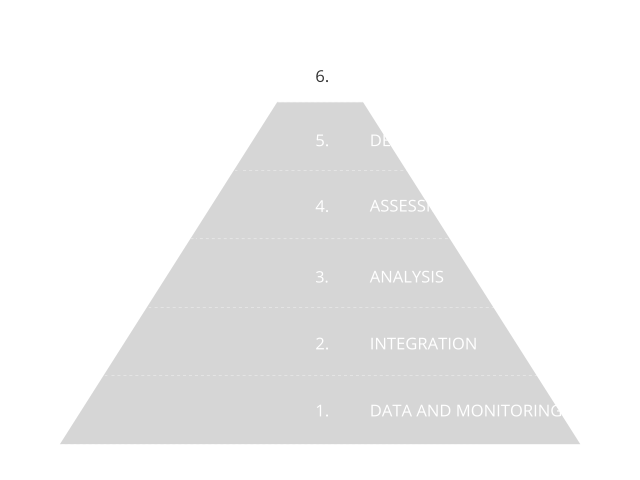
Environmental indicators are based on graphs, maps and assessments and as such present environmental trends in Slovenia. The indicators represent one of the four pillars of our environmental reporting, and are prepared in accordance with the Environmental Protection Act. The Environmental Indicators in Slovenia website enables users to browse among 180 indicators. They are based on numerical data and they indicate the state, characteristics and trends of environmental development in Slovenia. They are prepared using a systematic approach based on data and monitoring, as shown in the information pyramid.

Did you know?

Neutral

Asthma is the most common chronic disease among children and one of the major causes of hospitalization to the age of fifteen. In 2019, in EU countries, the share of people reporting asthma was 5,7 %, and for Slovenia it was 4,8 %.  In the period 2018-2022, the municipality of Kostel stood out in terms of the number of hospitalizations for asthma. Children admitted to the hospital for asthma in 2023 were mostly 5 to 9 years old.

Neutral

In recent years, the amount of wastewater treated by secondary or tertiary treatment processes increased, while primary treatment processes have closed. The amount of wastewater treated through secondary treatment processes increased by 150 % since 2000 or from 30 million m3 (in 2000) to almoust 45 million m3 (in 2019). There were almost no tertiary wastewater treatment processes in Slovenia in 2000, and in 2019, 72% of wastewater or 113 million m3 of wastewater was treated by tertiary process.

Bad

The incidence of malignant mesothelioma is (still) not decreasing in Slovenia or elsewhere in the world. Given the long latent period of the disease, it is likely to increase in Slovenia, especially among the elderly. Amon youngsters we expect to decline. We have not yet removed all asbestos products from the work and living environment, so the risk factor for this disease still exists, not only for workers who work professionally with asbestos products and waste, but also for others.

Neutral

In Slovenia, 98.7% of surface water bodies are in good chemical condition. The two water bodies are in poor chemical condition due to the excess of metals. In general, Slovenian surface waters are not loaded with priority substances in the water, but they are loaded with too high concentrations of mercury and brominated diphenylethers in fish. These are ubiquitous pollutants that are excessively present in biota both in Slovenia and in Europe.

Neutral

Water protection areas cover 3532 km2 or 17,4% of Slovenia’s land surface in 2021. This is a slight increase, compared to 2017, but the goal of protecting the areas of all water sources for public water supply with a regulation on national level, has not been reached yet.

Neutral
Air

Projections show a reduction in SO2, NOx, NMVOC, NH3 and PM 2.5 emissions by 2030, mainly due to more strict legislation and implementing a number of sectoral policy measures. Reduction is inline with set targets for 2020 and 2030. For PM2.5, NMVOC and SO2 emissions in 2030 are only slightly lower than according to targets, so there is a possibility that targets will not be met. To avoid that, it is of great importance that trends are regularly monitored and if necessary additional measures are prepared.