KAZALCI OKOLJA

Environmental indicators in Slovenia


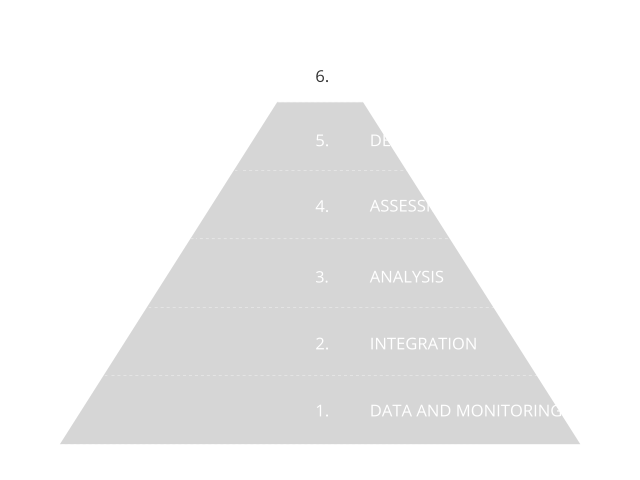
Environmental indicators are based on graphs, maps and assessments and as such present environmental trends in Slovenia. The indicators represent one of the four pillars of our environmental reporting, and are prepared in accordance with the Environmental Protection Act. The Environmental Indicators in Slovenia website enables users to browse among 180 indicators. They are based on numerical data and they indicate the state, characteristics and trends of environmental development in Slovenia. They are prepared using a systematic approach based on data and monitoring, as shown in the information pyramid.

Did you know?

Bad

The average age of the passenger car fleet in Slovenia has been steadily increasing; over the past thirty years, it has risen by almost four years — from 6.8 years in 1992 to 11.1 years in 2023. Over the past two decades, the share of cars older than 12 years has been continuously growing, by around 50% each decade. At the same time, the share of cars less than three years old has been steadily declining — by roughly 30% per decade.

Good

The number of organised visits to outstanding natural features almost tripled in the 1992-2008 period, and in 2008, 882.000 tickets were sold. By far the most visited natural feature is the Postojna Cave.

Neutral

In the upcoming years our primary objective is to implement and maintain an effective system of managing waste batteries and accumulators.

Good

The state of wildlife in Slovenia is favourable; larger epidemics have not been identified. The number of herbivorous ungulates as well as wild boars has decreased. An increase in wildlife losses due to road kill raises concerns. The total amount of damage caused by wildlife has decreased.

Wildlife management includes all animal and plant species. Regulation of wildlife populations is based on game management plans that are submitted for adoption to the Ministry of Agriculture, Forestry and Food by the Slovenia Forest Service in accordance with a prescribed procedure.

Neutral

Since 2004, the share of collected waste oils in relation to the quantity of oils sold grew from 15% to 30% in 2007, which is the target figure. In recent years, the share of recovered or incinerated waste oils compared to deposited oils is also increasing, which shows that this waste is used as additional energy-generating product. According to 2004 data, 4145 tonnes of waste oils were recovered, and 134 tonnes deposited.

Bad

Collected quantities of organic kitchen waste more than doubled after the implementation of the regulation, but its management has so far failed to achieve the set objectives. Deficiencies are particularly evident in composting. About 3,000 tonnes of such waste were composted in 2007, but so far only one entity obtained the environmental permit required for this activity.