KAZALCI OKOLJA

Environmental indicators in Slovenia


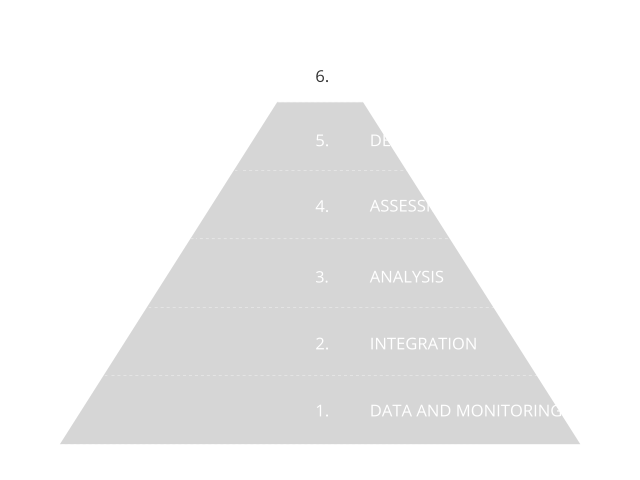
Environmental indicators are based on graphs, maps and assessments and as such present environmental trends in Slovenia. The indicators represent one of the four pillars of our environmental reporting, and are prepared in accordance with the Environmental Protection Act. The Environmental Indicators in Slovenia website enables users to browse among 180 indicators. They are based on numerical data and they indicate the state, characteristics and trends of environmental development in Slovenia. They are prepared using a systematic approach based on data and monitoring, as shown in the information pyramid.

Did you know?

Good

In 2023, around 182 million pieces of plastic carrier bags were placed on the Slovenian market, of which 99% were those with a wall thickness of less than 50 microns (light plastic carrier bags). In Slovenia, the consumption of lightweight plastic carrier bags amounted to 85 bags per capita in 2023 In the same year, 145.9 million pieces of single-use food containers made wholly or partly of plastic and 174.4 million pieces of single-use beverage cups made wholly or partly of plastic were placed on the Slovenian market.

Neutral

Higher levels of heavy metals and nitrogen are observed around the urbanized areas, industrial regions and around thermal power plants. The reason for elevated levels at the western part of Slovenia is transboundary transport of air pollutants from the Po Valley in Italy, however at the eastern part might be transit traffic and agricultural activity. A decrease of heavy metals and nitrogen in mosses is observed in Slovenia since 1995.

Good

In Slovenia, final users have at their disposal only around 73% of primary energy. In 2015 the rate reached its highest level. The efficiency of electricity and heat production is largely influenced by this share in far.

Neutral

Asbestos (six natural minerals with fibrous) becomes dangerous when the material is worn, damaged, or by removing. Asbestos was widely used in construction and industry until 2003, when Slovenia banned its production. In Slovenia 163,455 tons of waste containing asbestos was generated in the period from 2005 to 2015. The majority (99.5%) presents construction materials. Most of waste containing asbestos derives from households (82%).

Good

The decrease in SO2 emissions from transport is significantly influenced by the tightening of legislation governing the concentration of sulphur in liquid fuels (since 2009, it has been limited to 10 mg/kg for both petrol and diesel). The limit value of concentration of sulphur in fuels used in road transport in 2015 was not exceeded in Slovenia or in the EU-28; the same applies to air and maritime transport.