KAZALCI OKOLJA

Environmental indicators in Slovenia


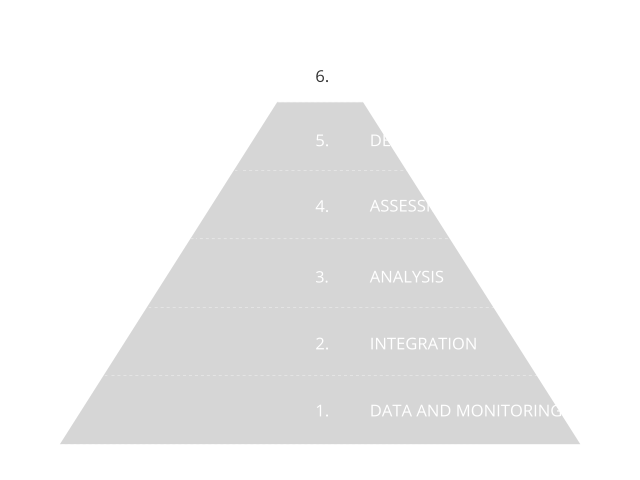
Environmental indicators are based on graphs, maps and assessments and as such present environmental trends in Slovenia. The indicators represent one of the four pillars of our environmental reporting, and are prepared in accordance with the Environmental Protection Act. The Environmental Indicators in Slovenia website enables users to browse among 180 indicators. They are based on numerical data and they indicate the state, characteristics and trends of environmental development in Slovenia. They are prepared using a systematic approach based on data and monitoring, as shown in the information pyramid.

Did you know?

Neutral
Sea

Between 1961 and 2023, the average sea level along the Slovenian coast increased. A comparison of the ten-year moving averages from the first decade (1961–1970) and the most recent decade (2014–2023) shows that the average annual sea level has risen by approximately 10 cm over this period. From 1961 to 1995, there was no statistically significant trend in sea level rise. However, starting in the 1990s, the sea level began to increase more noticeably. Since 1995, the average annual sea level has risen by about 3.5 mm per year.

Bad

In Slovenia, the breeding of indigenous domestic animals is becoming less attractive, and out of 15 indigenous breed 14 are endangered. The Carniolan honeybee being the only exception. Thirteen out of 14 traditional breeds are also endangered. The share of introduced animal breeds and crossbreeds with introduced breeds has been increasing. The breeds and races where the adaptation to natural conditions is the strongest are the most successful with defining the introduced breeds.

Neutral

Greenhouse gas emissions from agriculture decreased by 20.5% between 1986 and 2023. The largest declines occurred in pig and cattle production and in fertilizer application to agricultural crops. The rapid decline in emissions was typical of the early years of this period until 2013. From 2013 to 2016, emissions increased and then remained at a similar level until 2021, after which they decreased significantly. Slovenia achieved the target in 2023. Compared to 2005, emissions decreased by 7.4%.

Neutral

In Slovenia, the majority of energy consumption in agriculture is gas oil used as a propellant for agricultural machinery (59.0%), followed by energy for the production of mineral nitrogen fertilizers (34.7%) and electric energy (3.7%). Gas oil consumption has not changed significantly in the last ten years. Electricity consumption for storage is mainly influenced by the amount of fruit.

Good

The area of land involved in the implementation of agri-environmental measures increased by 49% between 2015 and 2022, most notably at the beginning of the programming period. The share of this land in the total utilised agricultural area (UAA) thus rose from around 14% to approximately 20% of all UAA.

Good

Slovenia has participated in the European Mobility Week (EMW) initiative from the very beginning. Its implementation has become an important form of promotion and encouragement of sustainable mobility planning in the last decade. Since the beginning of the implementation in 2002 165 Slovenian municipalities have participated in the EMW initiative at least once, and 7 municipalities every year. The number of participating municipalities has increased over the years and has already reached almost 80% of Slovenian municipalities.