KAZALCI OKOLJA

Environmental indicators in Slovenia


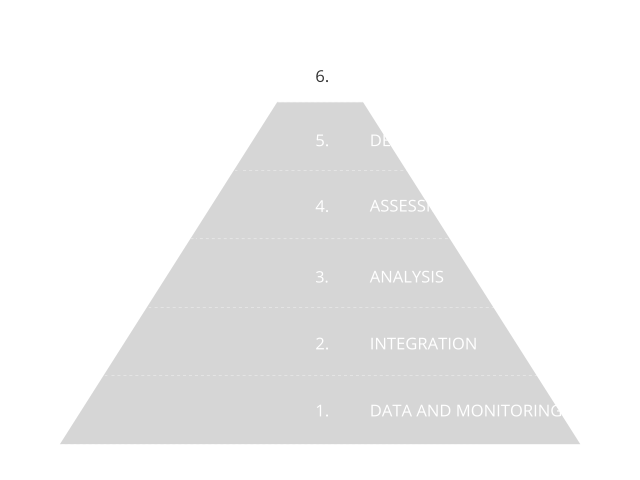
Environmental indicators are based on graphs, maps and assessments and as such present environmental trends in Slovenia. The indicators represent one of the four pillars of our environmental reporting, and are prepared in accordance with the Environmental Protection Act. The Environmental Indicators in Slovenia website enables users to browse among 180 indicators. They are based on numerical data and they indicate the state, characteristics and trends of environmental development in Slovenia. They are prepared using a systematic approach based on data and monitoring, as shown in the information pyramid.

Did you know?

Good

More than half of households in Slovenia have already used financial incentives for energy efficiency and renewable energy sources or are actively considering it. The index of household preferece for financial incentives offered by the Eco Fund increased positively by 4 index points from 2019 to 2022, when it was 52 on a scale from 0 to 100. Preference for these financial incentives varies between regions. On the one hand, knowledge and interest in the Eco Fund services is decreasing, while on the other hand, the share of households that have opted for these services again is increasing.

Neutral

Energy efficiency in transport is improving, but too slowly, as it improved by only 11% in the period 2000-2019. Most of the energy in traffic is consumed in passenger cars, where efficiency has deteriorated.

In households, energy efficiency improved by 33% over the same period, mainly due to an improvement in energy efficiency for heating. Most energy in households is used to heat homes.

Neutral

In recent years, the amount of wastewater treated by secondary or tertiary treatment processes increased, while primary treatment processes have closed. The amount of wastewater treated through secondary treatment processes increased by 150 % since 2000 or from 30 million m3 (in 2000) to almoust 45 million m3 (in 2019). There were almost no tertiary wastewater treatment processes in Slovenia in 2000, and in 2019, 72% of wastewater or 113 million m3 of wastewater was treated by tertiary process.

Bad

The incidence of malignant mesothelioma is (still) not decreasing in Slovenia or elsewhere in the world. Given the long latent period of the disease, it is likely to increase in Slovenia, especially among the elderly. Amon youngsters we expect to decline. We have not yet removed all asbestos products from the work and living environment, so the risk factor for this disease still exists, not only for workers who work professionally with asbestos products and waste, but also for others.

Neutral

In Slovenia, 98.7% of surface water bodies are in good chemical condition. The two water bodies are in poor chemical condition due to the excess of metals. In general, Slovenian surface waters are not loaded with priority substances in the water, but they are loaded with too high concentrations of mercury and brominated diphenylethers in fish. These are ubiquitous pollutants that are excessively present in biota both in Slovenia and in Europe.

Neutral

Water protection areas cover 3532 km2 or 17,4% of Slovenia’s land surface in 2021. This is a slight increase, compared to 2017, but the goal of protecting the areas of all water sources for public water supply with a regulation on national level, has not been reached yet.