KAZALCI OKOLJA

Environmental indicators in Slovenia


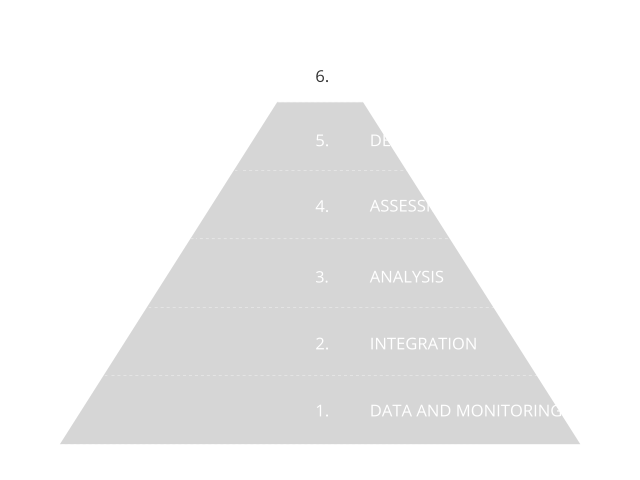
Environmental indicators are based on graphs, maps and assessments and as such present environmental trends in Slovenia. The indicators represent one of the four pillars of our environmental reporting, and are prepared in accordance with the Environmental Protection Act. The Environmental Indicators in Slovenia website enables users to browse among 180 indicators. They are based on numerical data and they indicate the state, characteristics and trends of environmental development in Slovenia. They are prepared using a systematic approach based on data and monitoring, as shown in the information pyramid.

Did you know?

Neutral

In the period 2022–2024, the share of agricultural land decreased by 0.3 %. The most significant declines were observed in overgrown agricultural area, arable land, and vineyards, while increases occurred in grasslands, less present agricultural land uses, and uncultivated agricultural land. A positive development during this period was the increase in the share of grasslands (permanent and wet grasslands), which may indicate a gradual restoration of agricultural landscape. Slovenia remains well bellow both the European and global averages in terms of arable land per capita.

Neutral

Regarding the forest area, deforestation accounts for an insignificant share. The average of the last ten years is approximately 405 ha (350–550 ha per year) and thus does not represent a significant factor in forest cover changes. Until 2008, most deforestation is a result of infrastructure facilities construction. In 2008, the unprecedented increase in deforestation for agricultural purposes occurred. The increase was due to the amendment to the Forest Act, which subject to the conditions allows the issuance of an authorisation for deforestation for agricultural purposes up to 0.5 ha.

Good

Forests in Slovenia are relatively well preserved, especially in terms of the diversity of the natural tree species composition and the vertical and horizontal stand structure. The share of preserved forests exceeds 50%. Heavily modified, mostly forests where natural tree species are altered with spruce, and altered forests make up just over a tenth of all forests.

Good

In the period 2005–2022, the land area in the organic farming measure more than doubled (from 20,477 to 50,540 ha). The target set by the Operational Programme for Reducing GHG Emissions until 2020 (OP GHG) for 2020 (44,000 ha) was already exceeded in 2018. The new targets of the Strategic Plan of the Common Agricultural Policy 2023–2027 are significantly more ambitious, and the past trends show that achieving them will be very challenging.

Neutral

Greenhouse gas emissions (GHG) per unit of milk produced show a clear and favourable downward trend after 2013. The target value for 2022 (< 0.704 kg CO2 eq per kg milk) was achieved. In beef production, the trend in emissions intensity after 2014 is favourable, but somewhat insufficiently intensive. It is not yet possible to comment on the achievement of the target, as the indicator, including the proposal for the target values for the period 2022–2030, was not proposed until 2023.

Neutral

After 2005, the gross nitrogen budget ranged between 32 and 69 kg per hectare of agricultural land with an indistinct downward trend. On average over the last five-year period, the target value (less than 50.4 kg per ha) was achieved. In 2022, the nitrogen balance surplus rose sharply compared to the previous year (from 46.2 to 69.1 kg per ha). The target value (less than 49.4 kg per ha) was therefore not achieved. The increase in the surplus is attributed to the drought, which caused a decrease in the nitrogen uptake by agricultural plants.