KAZALCI OKOLJA

Environmental indicators in Slovenia


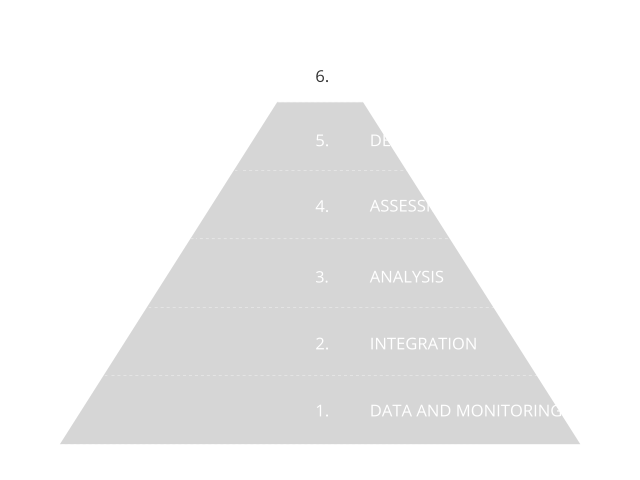
Environmental indicators are based on graphs, maps and assessments and as such present environmental trends in Slovenia. The indicators represent one of the four pillars of our environmental reporting, and are prepared in accordance with the Environmental Protection Act. The Environmental Indicators in Slovenia website enables users to browse among 180 indicators. They are based on numerical data and they indicate the state, characteristics and trends of environmental development in Slovenia. They are prepared using a systematic approach based on data and monitoring, as shown in the information pyramid.

Did you know?

Bad

Slovenia is at the infamous top of European countries in terms of the share of household expenditure on personal mobility. In Slovenia, households spent 17,5 % of household funds on personal mobility in 2022, namely 11,6 % for operation and 5,2 % for the purchase of vehicles. A smaller share, 0,8 %, was allocated to public transport. This does not take into account the annual depreciation cost of the car, which is the main cost for personal mobility in many households.

Good

Deadwood is an important animal and plant habitat that contributes to the biodiversity of forest ecosystems. According to Slovenia Forest Service data, the volume of standing and fallen trees without stumps and branches in 2022 was 21.3 m3/ha, which represented approximately 6% of the entire wood stock of forest stands. In virgin forests, however, the deadwood volume can be even several dozen times greater.

Good

In the past centuries, forest area has been increasing constantly after 2010; however, the rate of expansion has slowed down and remains relatively stable in recent years. Since 1875, when forests covered only 36% of the Slovenian territory, forest cover has increased to 58.5% in the year 2009 and rests stable today at 58.0 %. In terms of forest share, Slovenia ranks third among EU-28 countries, behind Sweden and Finland.

Good

In Slovenia, forests have been growing in terms of growing stock and increment for decades. They have increased by more than 140% over the last 70 years. In addition to natural conditions, harvesting depends on socioeconomic factors, and recently on the occurrence of natural disasters (windbreaks, icebreakers) and bark beetles outbreaks. By 2014, the felling accounted for about 50% of the increment. After the ice storm in 2014, it increased substantially and accounted for 60 to 75% of the total increment of conifers and deciduous trees.

Neutral

Regarding the forest area, deforestation accounts for an insignificant share. The average of the last ten years is approximately 405 ha (350–550 ha per year) and thus does not represent a significant factor in forest cover changes. Until 2008, most deforestation is a result of infrastructure facilities construction. In 2008, the unprecedented increase in deforestation for agricultural purposes occurred. The increase was due to the amendment to the Forest Act, which subject to the conditions allows the issuance of an authorisation for deforestation for agricultural purposes up to 0.5 ha.

Good

Forests in Slovenia are relatively well preserved, especially in terms of the diversity of the natural tree species composition and the vertical and horizontal stand structure. The share of preserved forests exceeds 50%. Heavily modified, mostly forests where natural tree species are altered with spruce, and altered forests make up just over a tenth of all forests.