KAZALCI OKOLJA

Environmental indicators in Slovenia


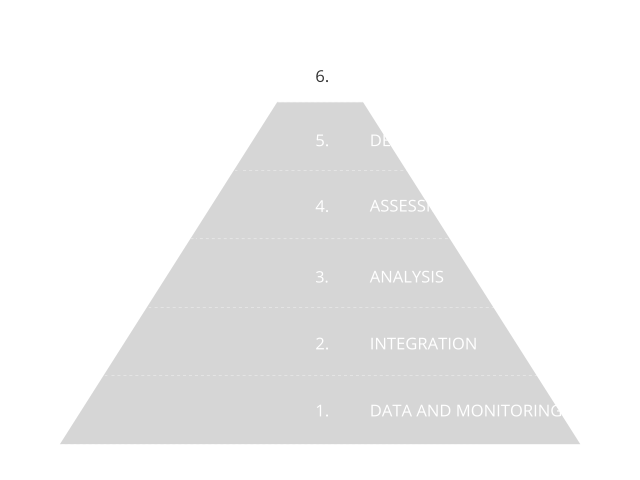
Environmental indicators are based on graphs, maps and assessments and as such present environmental trends in Slovenia. The indicators represent one of the four pillars of our environmental reporting, and are prepared in accordance with the Environmental Protection Act. The Environmental Indicators in Slovenia website enables users to browse among 180 indicators. They are based on numerical data and they indicate the state, characteristics and trends of environmental development in Slovenia. They are prepared using a systematic approach based on data and monitoring, as shown in the information pyramid.

Did you know?

Good

In the period 1992–2024 the consumption of mineral fertilizers in Slovenia was reduced by 41%. In the same period the consumption of plant nutrients (N, P2O5, K2O) per hectare of utilized agricultural area also reduced by 45%. The average consumption per hectare of utilized agricultural area was 61 kg N, 25 kg P2O5 and 30 kg K2O. In the period 2014–2023 the average consumption of nitrogen in Slovenia was lower (58 kg N/ha) than in EU member states (60 kg N/ha).

Bad

The results of the Energy Efficiency Survey of Slovenia - REUS show that the share of Slovenian households that are ready to start using or increase their use of public transport over the next 12 months remains quite small – a trend has not significantly changed during the 2011-2019 period. The data show that almost a tenth of households are ready, while a quarter of households are considering the option, while more than two thirds are not ready to start using or to increase their use of public transport.

Neutral

Due to high lead content in the environment, the Upper Meža Valley area was declared a brownfield site area in 2007 and underwent special remediation measures with the aim of protecting the health of people, especially children. Data shows that the lead exposure of children in the Upper Meža Valley improved rapidly in the early years of implementing the remediation measures, but no further improvement was observed after 2010. A prevalence study of lead levels in children's blood from the Meža Valley in 2018 even showed higher values compared to a study conducted in 2013.

Good

The Slovenian EHVZ database (Hydrography and Water Land Records) contains 67.549 watercourses with total length of 41.071 km. Total area of still waters is 24 km2 and river reservoirs 31 km2.

For use in water management, water land areas are delineated. Total area of water land in Slovenia is 387 km2, which is 1, 9 % of continental area of the Republic of Slovenia. Marine water land area is 214 km2.

Bad

Soil drought has a key impact on plant development and consequently on various industries (forestry, agriculture, …) . Indicators of the number of drought days and the duration of drought periods in individual years show an increase especially after 1990. Similarly, the analysis of the impact of the climate change up to 2100 shows that soil water deficits will increase in the future. The number and the duration of the droughts will increase.

Neutral

There are 17.431 parts of nature designated as valuable nature feature, among them 12.148 caves. Any construction or activity in a valuable natural feature area is allowed only if there is no other spatial or tehnical possibility.