KAZALCI OKOLJA

Environmental indicators in Slovenia


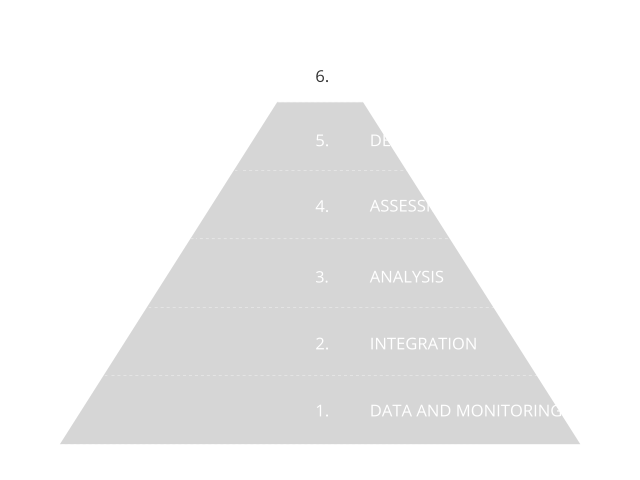
Environmental indicators are based on graphs, maps and assessments and as such present environmental trends in Slovenia. The indicators represent one of the four pillars of our environmental reporting, and are prepared in accordance with the Environmental Protection Act. The Environmental Indicators in Slovenia website enables users to browse among 180 indicators. They are based on numerical data and they indicate the state, characteristics and trends of environmental development in Slovenia. They are prepared using a systematic approach based on data and monitoring, as shown in the information pyramid.

Did you know?

Neutral

The export of waste from Slovenia decreased in 2020, for the first time after ten years of growth. We exported around 340 thousand tonnes of waste, mainly to Austria and Hungary. The import of waste also declined for the first time in 2020, we imported around 61 thousand tonnes of waste.

Neutral

While the declarative attitude of Slovenian households towards the environment and efficient use of energy is improving, the ratio between environmentally aware and unaware households remains unchanged. This is evident from their environmentally oriented behaviour and actual efficiency in energy use. The results of the Slovenian Energy Efficiency Survey – REUS indicate a great potential for reducing final energy consumption in households through the development of environmentally oriented behaviour and positive habits in energy use.

Bad

Research from the European Barometer (EBS) since 2008 has continuously testified to the high awareness of Slovenians about climate changes. Despite fluctuations in perception, for the majority – over two-thirds – climate change represents a very serious problem. Since 2015, we have observed a gradual increase in this awareness, which has surpassed three-quarters of respondents in the latest measurements. According to the most recent data from the REUS 2022 study, more than 80% of households recognize the severity of climate changes, confirming a high level of concern among the population.

Good

The trend of decreasing energy consumption in households between 2010 and 2022 indicates a positive attitude of the population towards efficient energy use. However, since 2017, a negative trend has been observed, particularly in households' awareness of their own energy consumption and in their consideration of more efficient use. With three-quarters of households in 2022 rating their energy consumption as medium to very high, a significant potential for reducing energy consumption in this sector is suggested.

Good
Sea

Phytoplankton biomass, expressed as chlorophyll a concentration, reflects nutrient loading in the marine environment. Chlorophyll a concentrations shows a trend towards improvement in the status of the Slovenian sea, as the ecological status has been assessed as high or good over the last period.

Good

Deadwood is an important animal and plant habitat that contributes to the biodiversity of forest ecosystems. According to Slovenia Forest Service data, the volume of standing and fallen trees without stumps and branches in 2022 was 21.3 m3/ha, which represented approximately 6% of the entire wood stock of forest stands. In virgin forests, however, the deadwood volume can be even several dozen times greater.