KAZALCI OKOLJA

Environmental indicators in Slovenia


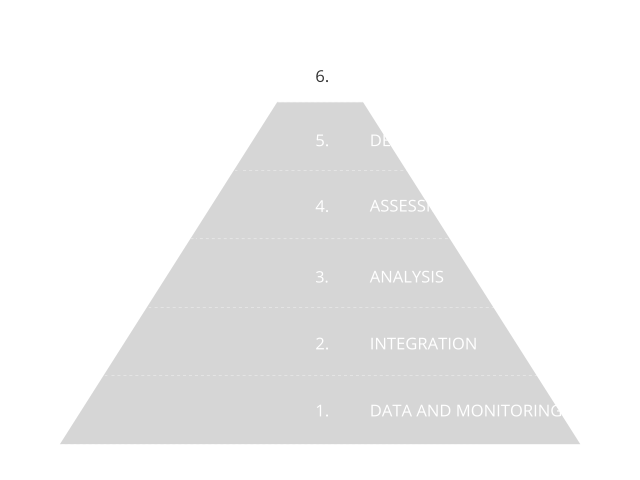
Environmental indicators are based on graphs, maps and assessments and as such present environmental trends in Slovenia. The indicators represent one of the four pillars of our environmental reporting, and are prepared in accordance with the Environmental Protection Act. The Environmental Indicators in Slovenia website enables users to browse among 180 indicators. They are based on numerical data and they indicate the state, characteristics and trends of environmental development in Slovenia. They are prepared using a systematic approach based on data and monitoring, as shown in the information pyramid.

Did you know?

Good

Designated areas, which include Natura 2000 and protected areas, cover 40% of the total area of the country, which is almost six times more than in 1992. The increase in designated areas is due to designation of Natura 2000 network in 2004 and more landscape parks from 2008 until 2019. For any planned construction activity on designated areas a nature conservation consent is needed.

Bad

In 2016 and 2017, the trend of reducing specific emissions of new vehicles has stopped, and in 2018 and 2019 they have even increased. After a 10% reduction in 2020, the specific emissions of new vehicles remained almost unchanged in 2021, falling short of the target set for that year. In 2022, the specific emissions of new vehicles decreased again, by 6%.

In 2021, for the first time since 2016, the average emissions of all vehicles increased slightly in comparison to the previous year. Target values have not been achieved.

Neutral

Areas of fields and gardens in measures that require fertilization based on rapid soil or plant tests have significantly exceeded the target value set by the 2014–2020 Rural Development Programme.

Good

In the period after 2000, nitrogen consumption from mineral fertilisers initially declined. After 2009, consumption more or less stabilised at around 27,500 tonnes, with annual values ranging from 26,300 to 29,143 tonnes. With the exception of 2021, the target value (< 28,000 t) has been achieved in recent years. The increase in 2021 was probably the result of purchases of mineral fertilizers for stock, which were made due to expected price increases and supply disruptions.

Good

In the period 2005–2022, the land area in the organic farming measure more than doubled (from 20,477 to 50,540 ha). The target set by the Operational Programme for Reducing GHG Emissions until 2020 (OP GHG) for 2020 (44,000 ha) was already exceeded in 2018. The new targets of the Strategic Plan of the Common Agricultural Policy 2023–2027 are significantly more ambitious, and the past trends show that achieving them will be very challenging.

Neutral

Greenhouse gas emissions (GHG) per unit of milk produced show a clear and favourable downward trend after 2013. The target value for 2022 (< 0.704 kg CO2 eq per kg milk) was achieved. In beef production, the trend in emissions intensity after 2014 is favourable, but somewhat insufficiently intensive. It is not yet possible to comment on the achievement of the target, as the indicator, including the proposal for the target values for the period 2022–2030, was not proposed until 2023.