KAZALCI OKOLJA

Environmental indicators in Slovenia


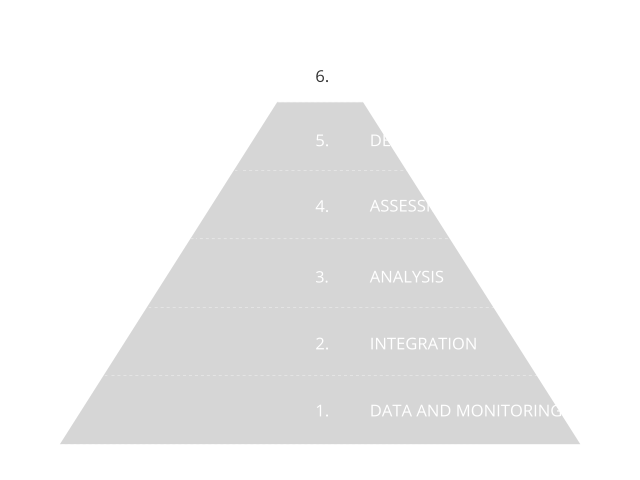
Environmental indicators are based on graphs, maps and assessments and as such present environmental trends in Slovenia. The indicators represent one of the four pillars of our environmental reporting, and are prepared in accordance with the Environmental Protection Act. The Environmental Indicators in Slovenia website enables users to browse among 180 indicators. They are based on numerical data and they indicate the state, characteristics and trends of environmental development in Slovenia. They are prepared using a systematic approach based on data and monitoring, as shown in the information pyramid.

Did you know?

Neutral

Air pollution is the most important environmental risk factor for human health, affecting an average of 400,000 premature deaths in the EU and costing Europeans an average of more than € 166 billion a year. In the case of the cities of Ljubljana and Maribor, external costs amount to almost EUR 271 million annually. Estimation of external costs of air pollution from transport is slightly decreasing.

Neutral

In Slovenia, just over 1.1 million tonnes of municipal waste were generated in 2023, which is 7 % more than the previous year, of which 69 % was collected separately. 26 % of municipal waste generated was packaging waste. In 2023, more than 294.000 tonnes of packaging waste were generated in Slovenia, of which more than one fifth was plastic packaging waste.

Neutral

The share of waste electrical and electronic equipment (WEEE) disposed of within mixed municipal waste annually in the period 2020-2023 represented an average of 0.8% of collected mixed municipal waste. The share of waste batteries and accumulators (WBAs) was even lower, representing an average of 0.03% of all collected mixed municipal waste in the same period annually. The amount of separately collected WEEE has been increasing over the years. In Slovenia, just over 16,600 tonnes of WEEE were collected separately in 2023, which is almost 8% more than in 2022.

Neutral

In recent years, the number of sampling sites where individual pesticides exceed the quality standard has been decreasing. The concentration of pesticides in groundwater is also declining. However, in areas of Slovenia characterized by intensive agricultural activity, some pesticides still exceed the quality standard.

Bad

The average occupancy rate of cars in Slovenia is declining. In heavy goods transport, average occupancy is increasing as a result of the growing share of tractor units in freight transport, which have a higher load capacity. The NEPN emphasizes the importance of increasing vehicle occupancy – e.g., by promoting carpooling, developing appropriate infrastructure, and organizing freight transport more efficiently—as an important contribution to reducing GHG emissions and energy consumption, while governing transport demand and shifting to more sustainable forms of transport.

Neutral

In 2022, the number of employees in the environmental goods and services sector increased by 4.2%. The share of employees in this sector in relation to all employees in Slovenia has not changed much in recent years. Slovenia's goal is to increase the number of green jobs, the target value has, however, not been set. In order to compare the situation in Slovenia with that in the EU, changes compared to the previous year are monitored.