KAZALCI OKOLJA

Environmental indicators in Slovenia


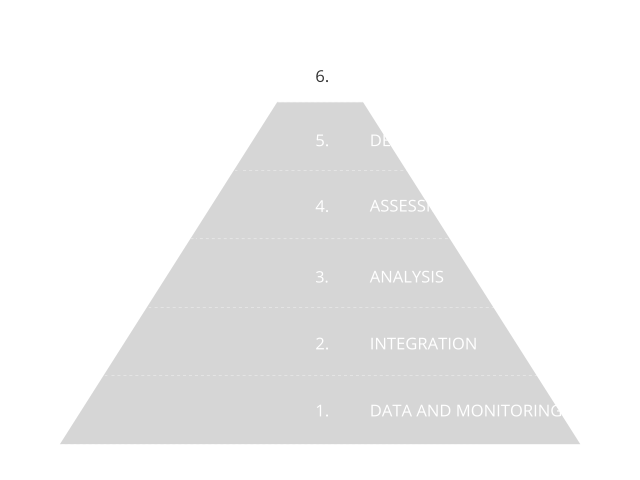
Environmental indicators are based on graphs, maps and assessments and as such present environmental trends in Slovenia. The indicators represent one of the four pillars of our environmental reporting, and are prepared in accordance with the Environmental Protection Act. The Environmental Indicators in Slovenia website enables users to browse among 180 indicators. They are based on numerical data and they indicate the state, characteristics and trends of environmental development in Slovenia. They are prepared using a systematic approach based on data and monitoring, as shown in the information pyramid.

Did you know?

Bad

Slovenia is at the infamous top of European countries in terms of the share of household expenditure on personal mobility. In Slovenia, households spent 17,5 % of household funds on personal mobility in 2022, namely 11,6 % for operation and 5,2 % for the purchase of vehicles. A smaller share, 0,8 %, was allocated to public transport. This does not take into account the annual depreciation cost of the car, which is the main cost for personal mobility in many households.

Neutral

Both the residents of the EU-27 countries and the residents of Slovenia are only partially aware of the problem of increasing transport and its consequences for the environment and health. Public awareness of the impact of transport on the environment is still relatively low, although the differences between European countries are considerable. People's awareness of the environmental problems of transport does not automatically lead to changing their travel habits, even though this would contribute to their better health.

Bad

Road freight transport in Slovenia has grown sharply since the country’s accession to the EU, with the volume of tonne-kilometres carried by Slovenian hauliers alone increasing more than 2.5 times between 2004 and 2024. After the pandemic-related slowdown, the volume of road freight transport returned to previous levels.

Bad

In Slovenia, the volume of passenger transport and traffic has been increasing over the past few decades. In particular, there has been a steady rise in one of the most environmentally damaging modes of transport – car travel. Its share places Slovenia in the unenviable fourth place among EU member states whose residents rely most heavily on private cars for their journeys.

Neutral

In Slovenia, in 2023, monitoring of drinking water quality was carried out for 92.3% of the population, at the point of use (user's tap) on drinking water supply systems, or in 861 supply zones that supplied 50 or more inhabitants and included 25 smaller supply areas, which also supplied public facilities, facilities for the food production. In the drinking water monitoring did not include 7.7% of the population of Slovenia, which supplies fewer than 50 persons e.g. individual supply providing, rainwater.

Neutral

The main source of renewable energy from agriculture in Slovenia is the production of electricity from biogas. Electricity production from "agricultural" biogas plants included in the support scheme for electricity produced from RES increased from 0.04 kToe in 2004 to 10.67 kToe in 2011 and then fell to 5.18 kToe in 2024. The decline in electricity production in recent years is mainly due to the expiration of the right to support, which lasts for 15 years.