KAZALCI OKOLJA

Environmental indicators in Slovenia


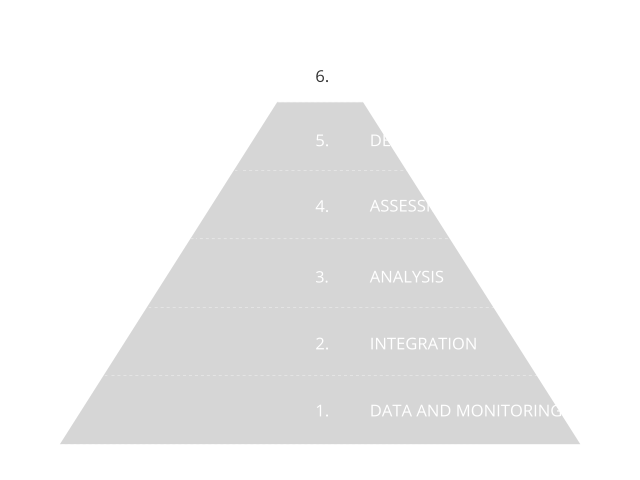
Environmental indicators are based on graphs, maps and assessments and as such present environmental trends in Slovenia. The indicators represent one of the four pillars of our environmental reporting, and are prepared in accordance with the Environmental Protection Act. The Environmental Indicators in Slovenia website enables users to browse among 180 indicators. They are based on numerical data and they indicate the state, characteristics and trends of environmental development in Slovenia. They are prepared using a systematic approach based on data and monitoring, as shown in the information pyramid.

Did you know?

Good

In Slovenia, slightly more than 106,000 tonnes of municipal waste were landfilled at 10 non-hazardous waste landfills in 2023, compared to slightly more than 90,000 tonnes the year before. The increase in landfilled municipal waste in 2023 was the result of the extensive floods that hit Slovenia during the summer of that year.

The share of landfilled municipal waste at the EU level in 2023 was 22% of generated municipal waste. The countries in which more than half of generated municipal waste was landfilled include Greece, Romania, Malta, Cyprus, Portugal, Hungary, and Bulgaria.

Neutral

The share of waste electrical and electronic equipment (WEEE) disposed of within mixed municipal waste annually in the period 2020-2023 represented an average of 0.8% of collected mixed municipal waste. The share of waste batteries and accumulators (WBAs) was even lower, representing an average of 0.03% of all collected mixed municipal waste in the same period annually. The amount of separately collected WEEE has been increasing over the years. In Slovenia, just over 16,600 tonnes of WEEE were collected separately in 2023, which is almost 8% more than in 2022.

Neutral

In recent years, the number of sampling sites where individual pesticides exceed the quality standard has been decreasing. The concentration of pesticides in groundwater is also declining. However, in areas of Slovenia characterized by intensive agricultural activity, some pesticides still exceed the quality standard.

Bad

The average occupancy rate of cars in Slovenia is declining. In heavy goods transport, average occupancy is increasing as a result of the growing share of tractor units in freight transport, which have a higher load capacity. The NEPN emphasizes the importance of increasing vehicle occupancy – e.g., by promoting carpooling, developing appropriate infrastructure, and organizing freight transport more efficiently—as an important contribution to reducing GHG emissions and energy consumption, while governing transport demand and shifting to more sustainable forms of transport.

Neutral

In 2022, the number of employees in the environmental goods and services sector increased by 4.2%. The share of employees in this sector in relation to all employees in Slovenia has not changed much in recent years. Slovenia's goal is to increase the number of green jobs, the target value has, however, not been set. In order to compare the situation in Slovenia with that in the EU, changes compared to the previous year are monitored.

Neutral

The implicit tax rate on energy in Slovenia amounted to 247 €/toe in 2023, which is 4% higher than in the previous year but still 17% lower than in 2016, when it reached its peak for the period 2012–2023. Compared with the EU-27, it was 3.6% above the EU average in 2023, while it was below the European average only in the years 2020–2022 due to temporary crisis-related measures. In addition to tax policy, the rate is also influenced by changes in the structure of energy consumption and energy efficiency.