KAZALCI OKOLJA

Environmental indicators in Slovenia


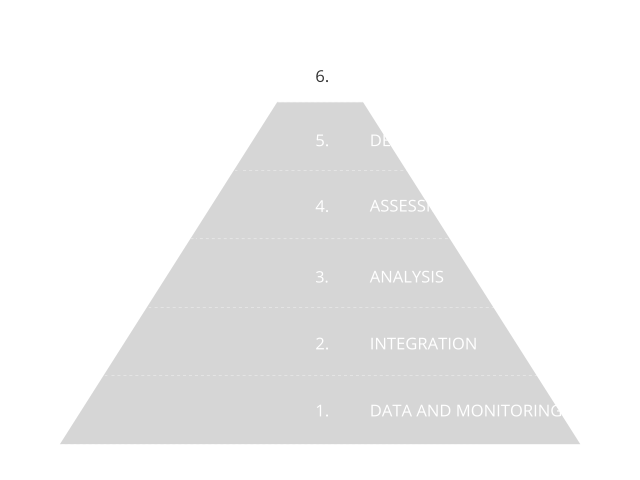
Environmental indicators are based on graphs, maps and assessments and as such present environmental trends in Slovenia. The indicators represent one of the four pillars of our environmental reporting, and are prepared in accordance with the Environmental Protection Act. The Environmental Indicators in Slovenia website enables users to browse among 180 indicators. They are based on numerical data and they indicate the state, characteristics and trends of environmental development in Slovenia. They are prepared using a systematic approach based on data and monitoring, as shown in the information pyramid.

Did you know?

Good

In the period 1992–2024 the consumption of mineral fertilizers in Slovenia was reduced by 41%. In the same period the consumption of plant nutrients (N, P2O5, K2O) per hectare of utilized agricultural area also reduced by 45%. The average consumption per hectare of utilized agricultural area was 61 kg N, 25 kg P2O5 and 30 kg K2O. In the period 2014–2023 the average consumption of nitrogen in Slovenia was lower (58 kg N/ha) than in EU member states (60 kg N/ha).

Bad

The eco-innovation index shows the performance of individual Member States in the various components of eco-innovation compared to the EU average, and presents their strengths and weaknesses. The overall Eco-innovation Index 2019 for Slovenia is 94, placing Slovenia on 15th rank and below the EU average. Slovenia composite index has significantly deteriorated compared to 2017, when it was at 115; placing Slovenia just behind the leading eco-innovative countries.

Good

One of the main sources of greenhouse gas emissions in Slovenia is road traffic, as passenger vehicles contribute as much as 20 % of all greenhouse gas emissions. It is estimated that, due to the smaller role of public passenger transport in Slovenia, it is necessary to achieve as much as 2/3 reduction of GHG emissions by electrifying the vehicle fleet, which dictates the replacement of existing vehicles with fossil fuels. with electric vehicles (battery and plug-in hybrids EV).

Bad

Since 2017, as a result of the introduction of the fuel price supplement due to the mixing of biofuels, use of biofuels has increased. In 2020, 10.9% RES share in the transport sector has been achieved. Biofuels contributed 94 % to this share, with some biofuels multiplied by multiplier factors in the calculation of the RES share. Biofuels accounted for less than 6% in 2020 in transport energy use, with one sixth of advanced biofuels.

Bad

In 2018, the ecological footprint of Slovenia was 5,37 gha per capita while biocapacity was 2.2 gha. For such a lifestyle 3.39 Earths would be required for the world's population to live within planetary regenerative capacity. This places Slovenia above the average of the EU countries (4.6 gha per capita). The carbon footprint usually accounts for around 60% of the total ecological footprint and therefore needs to receive comparatively more attention. According to consumption categories, housing and personal transportation contribute the most to the ecological footprint in Slovenia.

Good

Energy use contributes 79% to total greenhouse gas emissions in Slovenia. The biggest sources of emissions are electricity and heat production and transport. With the introduction of the EU Greenhouse Gas Emissions Trading Scheme (EU-ETS) Member States targets for GHG's covered only emissions from nonETS sources. Transport is by far the largest source of on nonETS emissions in Slovenia with 47%, while  emissions from energy use contribute 73%. The 2020 target has been achieved. Target for the following years are significantly more ambitious.